If you’re new to modern bidets, the control panel can feel a bit like the cockpit of an airplane; especially when you spot the two main cleaning options: the front wash and the rear wash. You are then left with the option of choosing between a front wash vs. rear wash.
While both are designed to replace dry toilet paper with a cleaner, gentler stream of water, they serve entirely different purposes, body angles, and hygiene needs. Here is a quick breakdown of how each setting works, who benefits most, and how to dial in the perfect clean every time.
The choice shows up on every product page: one nozzle or two? If you are new to all this, our topic on how does a bidet work covers the basics first. But then, let’s explain them.
Front Wash vs. Rear Wash: What Is Rear Wash?
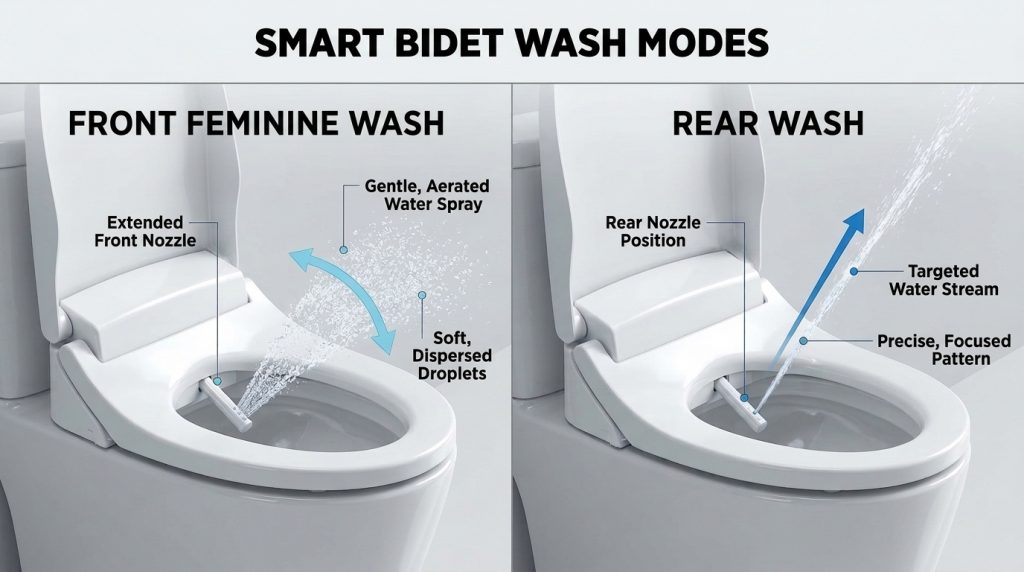
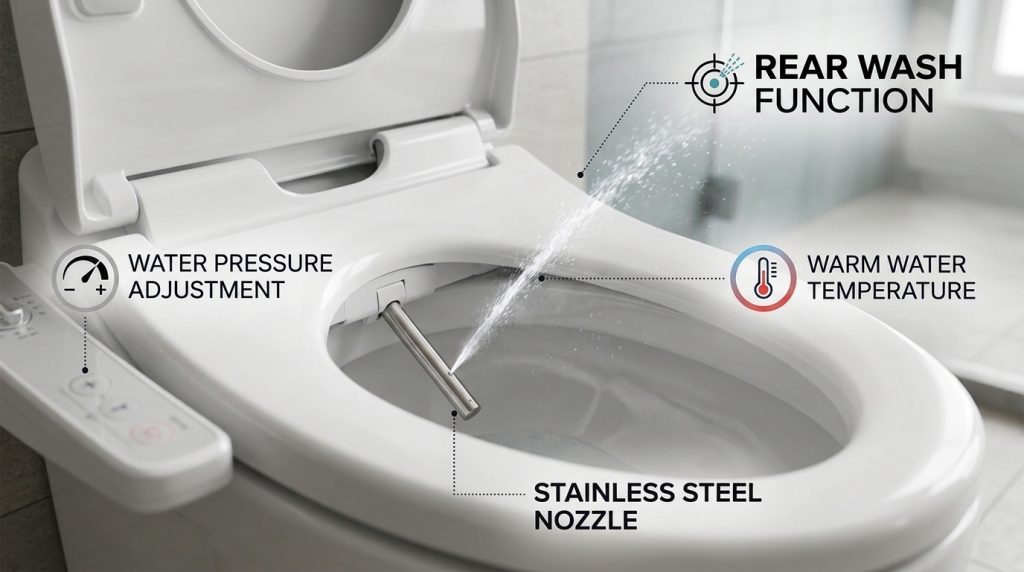
Rear wash, also called posterior wash, is the default setting on every bidet. The nozzle sits at the back of the bowl and sprays upward and forward at the anus and the area around it.
How the rear nozzle is built
The rear nozzle is angled to reach the target from behind, so water lands where paper would normally wipe. Its spray is firmer than the front nozzle’s, because the job is rinsing off stool residue. Electric models add settings such as an oscillating pattern that sweeps the area, plus adjustable position and pressure.
Non-electric ones rely on a pressure dial. If you are choosing between the two, here is our guide on electric vs non-electric bidet: and know which one you should buy.
Who it suits
Anyone who wants to clean after a bowel movement. People with hemorrhoids or fissures often like it because water avoids the friction of wiping, but pressure matters. A colorectal practice’s guide advises starting at low pressure, using warm rather than hot water, and patting dry. Too much force is the usual way people irritate themselves, which is covered in when an answering if a bidet can be harmful.
What Is Front Wash?
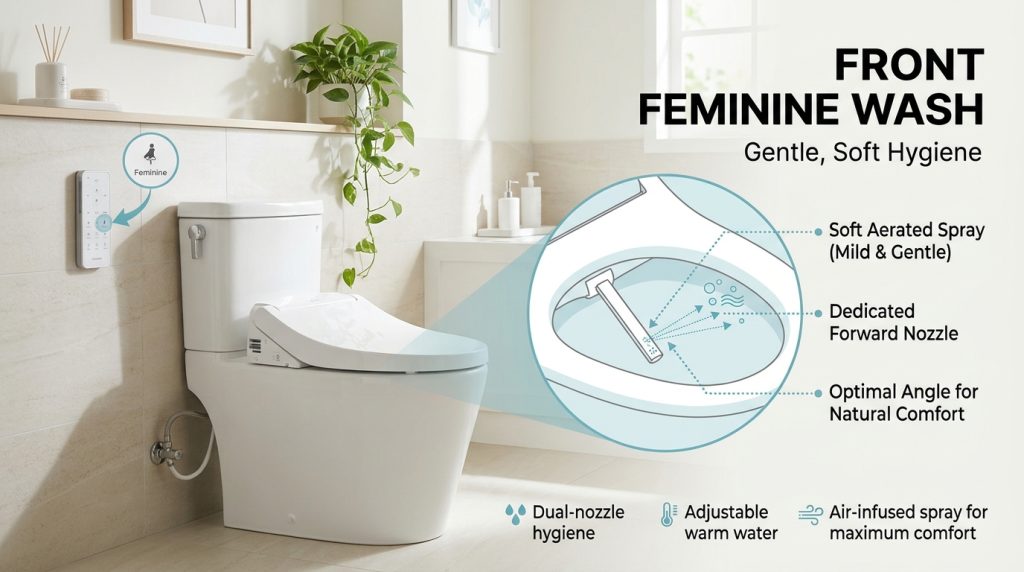
Front wash, or feminine wash, uses a second nozzle that sits slightly forward and aims at the vulva. The point is to rinse the outer genitals after urinating, during a period, or after sex, without touching anything. However, there are specific bidets that has this particular front wash or feminine wash.
How the front nozzle differs
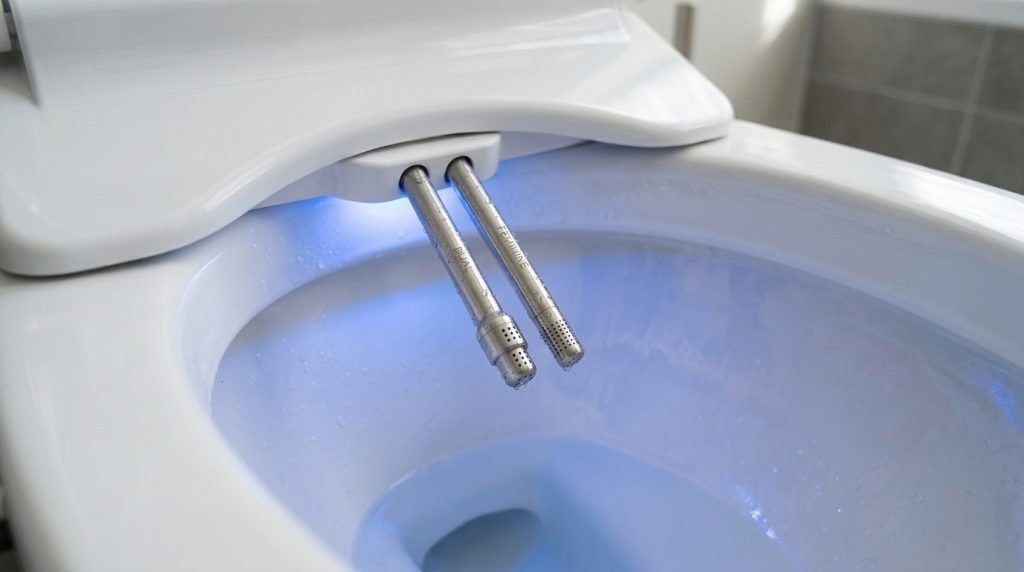
The front nozzle sprays wider and softer than the rear one, because the skin there is more delicate. On dual-nozzle models each wand runs on its own, so you can use the front wash only when you need it. Many people use it for a one- or two-second rinse after peeing. It is a good replacement for feminine wipes, which are often scented and can irritate.
The rule that matters: outside only
Front wash is for the external area. The vagina cleans itself, and Medical News Today is blunt about it: rinse the outer area with warm water, keep soap out of the vagina, and skip douching, which can cause inflammation and alter vaginal pH. A bidet aimed at the vulva is not a douche, and bidet usage and douching are separate things. Just don’t point the stream inward or hold it for long.
After childbirth, Boston Medical Center’s perineal care advice is to rinse with warm water, pat dry, and not wash inside the vagina. Check with your provider if yours differs. There are step-by-step ways, to use all bidets as a woman.
Front Wash vs. Rear Wash: Side-by-Side
| Rear wash | Front wash | |
|---|---|---|
| Cleans | Anus and surrounding skin | Vulva (external only) |
| Nozzle position | Back of the seat or bowl | Slightly forward |
| Spray | Firmer, narrower | Softer, wider |
| Typical use | After a bowel movement | After urinating, periods, postpartum |
| Needs a second nozzle | No, it is standard | Yes, dual-nozzle models |
| Who uses it | Everyone | Mostly women |
| Pressure tip | Start low, raise slowly | Keep low |
The practical difference is the angle and the force. Mixing them up is why some people get irritated.
Who Needs Front Wash, and Who Can Skip It?
Women
You will use both. Buy a dual-nozzle model if you can. A single nozzle can be repositioned on some units, but it is a compromise. If you are shopping for the best bidet for women, narrows it down to the best ones, as bidets are sanitary for woman contrary to the wrong hygiene that worries most people.
On wiping direction, the advice is mixed. A urologist quoted by TODAY says direction rarely matters for the average adult. Others, including Mayo Clinic, still recommend front to back. It does no harm, so the safe habit is to aim and wipe from front to back. Don’t count on a bidet to prevent UTIs. If you get three in a year, see a doctor.
Men
The rear wash is the one you need. Shift slightly on the seat to aim it. Our article on how to use a bidet as a man, has the details.
Postpartum and recovery
Front wash is the useful one. It acts like a hands-free peri bottle, with warm water and no friction. Keep pressure at the lowest setting.
Sensitive skin, hemorrhoids and fissures
Rear wash at low pressure with warm water. Stop if it hurts.
Children and people with incontinence
The TODAY piece notes the direction advice matters more for babies, children and people with incontinence. For kids, supervise, use the lowest pressure, and show them how to aim front to back.
How to Use Front and Rear Wash Correctly
There are full routine on how to use a bidet. However, there are the points that apply to the two nozzles.
- Sit back and aim. Sit normally, then shift a little forward or back until the stream hits the right spot. Move first, then turn the water on.
- Start at low pressure. Raise it slowly. Higher is not cleaner, and force is what causes irritation.
- Front first, rear last. If you use both, rinse the front, then the rear. Never run the rear stream and then the front.
- Keep it short. A front rinse takes a second or two. The rear wash takes longer, but stop when you feel clean, usually well under a minute.
- Dry gently. There are ways to dry after using a bidet. But for the simple part, pat with a little toilet paper or a dedicated towel, or let it air dry. Don’t rub.
Keeping Both Nozzles Clean
Two nozzles means two things to look after. Both live near the bowl, and both can pick up mineral scale in hard-water areas.
- Use the self-clean rinse. Most models rinse the nozzle before and after use. If yours has a manual cleaning mode, run it.
- Wipe each nozzle weekly. Pull the wand out and wipe it with mild soap and a soft brush. Keep the front nozzle as clean as the rear one.
- Watch for blocked holes. Scale can narrow the spray. If the stream looks uneven, clean the holes. Steps are in [How to Clean a Bidet Nozzle].
- Skip scented products near the front nozzle. The skin there is sensitive.
In shared bathrooms, wash your hands after using the controls, maintain proper bidet hygiene and keep towels separate and maintain proper bidet towel etiquette.
Common Mistakes With Front and Rear Wash
- Pressure too high. The most common error, and the main cause of irritation.
- Aiming the front stream inward. Keep it on the outer skin.
- Washing for too long. More time does not mean cleaner. It dries and irritates the skin.
- Hot water. Warm is fine. Hot is harsh on sensitive tissue.
- Skipping the dry. A colorectal practice warns that poor drying leaves moisture, which can irritate and contribute to infection. Pat dry every time.
Choosing Between One Nozzle and Two
For front wash, you need two nozzles that work independently. Check three things before you buy: each nozzle can be switched on its own, pressure is adjustable, and the wands retract behind a cover when not in use. A self-cleaning rinse is worth having on both.
Budget pick: a non-electric dual-nozzle unit, which is mostly in bidet attachments. Comfort pick: which are found on electric seat with warm water, they can also have adjustable nozzle position and presets. If you want to adjust settings without leaning over, go for the best bidets with remote control.
Frequently Asked Questions
Do I need a dual-nozzle bidet?
If you want a front wash, yes. A single-nozzle bidet gives rear wash only, although some adjustable models let you shift the nozzle forward. Men can usually manage with one nozzle. If the costs is your worry, there are bidet attachments that have options that include two nozzles.
Is front wash the same as douching?
No. Douching puts water inside the vagina. Front wash rinses the outside, and you should keep it there. Medical News Today says douching is unnecessary. Our article on “bidet vs douching” has the full answer.
Can I use front wash during my period?
Yes, as an external rinse with warm water at low pressure. Don’t aim inside. Pat dry before putting on a new pad or product.
Can men use front wash?
There is no need. Rear wash does the job, and you can shift on the seat to aim it. If you are curious how bidets fit different bodies, the debate of who to use a bidet between a man and a woman has already been settled.
Final Thoughts
Front Wash vs. Rear Wash is simple once you know the angle and the rule: rear for the back, front for the outside only, low pressure for both. Choose a dual-nozzle model if you want both, and keep the nozzles clean. For help picking, start with here is our complete guide on how to choose the best and right bidet.