
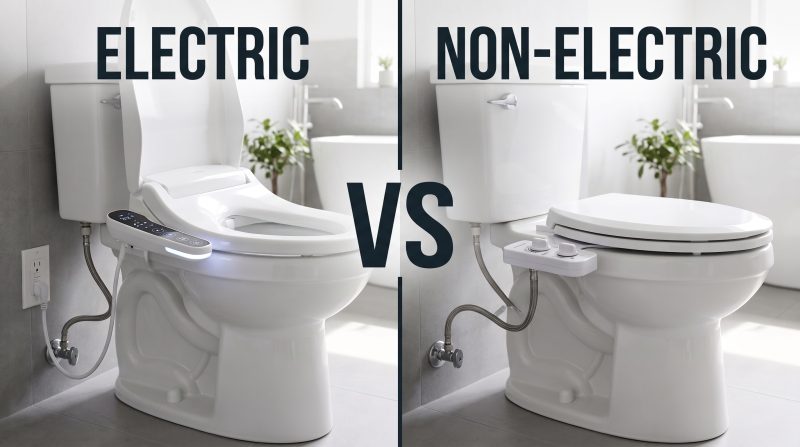
If you are upgrading your bathroom routine, moving away from dry toilet paper is one of the most hygienic decisions you can make. However, the first hurdle most buyers face in the electric vs non-electric bidet debate is deciding which style fits their home.
While both dramatically improve cleanliness, they offer entirely different user experiences, installation demands, and price tags. Here is an in-depth breakdown of how each type functions, how they stack up in head-to-head performance, and which model best aligns with your budget and bathroom configuration.
Electric vs Non-Electric Bidet at a Glance
Buy a non-electric bidet if you want a low-cost, plug-free upgrade that works in rentals and during power cuts. Choose electric if warm water, a heated seat and adjustable settings matter to you and you have a GFCI outlet beside the toilet. Water temperature is usually the deciding factor.
| Factor | Non-electric bidet | Electric bidet |
| Typical price (US, unit only) | About $20 to $120 | About $170 to $650; premium models cost more |
| Water temperature | Room temperature; warm only with a hot-line hookup on dual-inlet models | Heated on demand or from a tank, adjustable |
| Power needed | None | 120 V outlet; manufacturers specify a GFCI-protected one |
| Spray pressure | Driven by household pressure, set with a knob; can be strong | Pump-regulated, usually gentler |
| Install time | About 20 to 45 minutes with basic tools | About 20 to 45 minutes, plus an outlet if none is nearby |
| Works in a power cut | Yes | Most models do not |
| Electricity use | None | Small in light use; rises if the seat heater stays on |
| Extras | Dual nozzles on some models | Heated seat, air dryer, deodorizer, remote, night light |
What Is a Non-Electric Bidet?
A non-electric bidet is any bidet that runs on your home’s water pressure alone. There is no plug, no battery and no circuit board, just a valve, a hose and a nozzle. It is the simplest way to add a water wash to a toilet you already own.
How Non-Electric Bidets Work
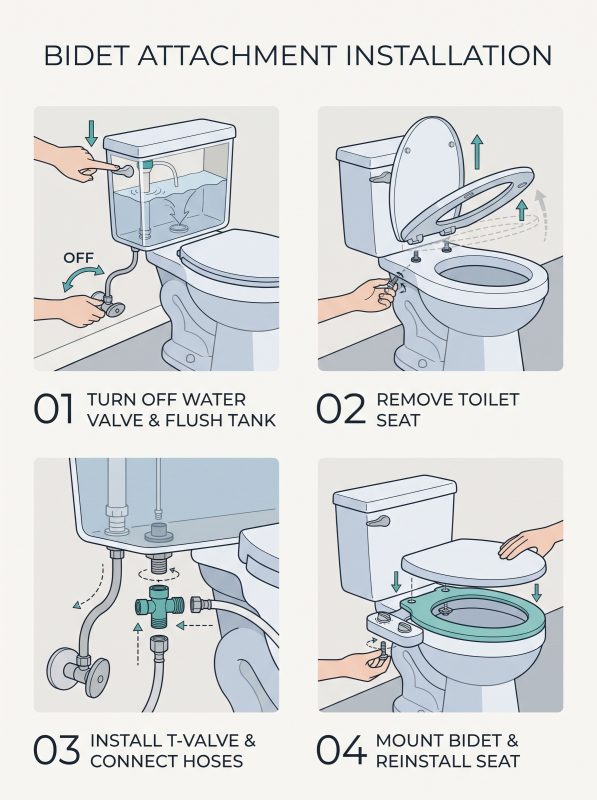
The unit taps into the cold water line that feeds your toilet tank. A T-valve goes between the shut-off valve and the tank, a braided hose runs from that valve to the bidet, and a knob or lever on the bidet opens the flow. Turn it further and the spray gets stronger. Many models have a retractable nozzle, and a rinse setting that sends clean water over the nozzle between uses.
Because nothing heats the water, you get whatever is sitting in the pipe. That is room temperature at best, and noticeably cold in winter. Some dual-temperature models solve this without electricity by adding a second connection to the hot line under your bathroom sink. Brondell’s manual for one such unit says the hot supply should be within about 6 feet, and owners of similar models report the hot water takes a minute to arrive if the water heater is far away. Run the sink first, or live with a cool first few seconds. If you only hook up cold water, a cap goes over the unused hot inlet.
Pressure is the other thing worth knowing. A non-electric bidet uses the supply pressure itself, which can be strong. One plumbing-focused guide notes that some homes push well past 100 PSI, so a model with a good pressure dial matters.
Types of Non-Electric Bidets
- Seat-mounted attachment. A slim unit that sits between the bowl and your existing seat. This is the most common type, it fits both round and elongated toilets because it sits under the seat, and most people install it in about 20 minutes.
- Dual-temperature attachment. The same idea with a hot-water hookup for a warm wash. Examples cited by retailers include the Bio Bidet BB-250 and the Brondell FreshSpa Dual.
- Handheld bidet sprayer. A small spray wand on a hose, mounted beside the toilet. It works like a kitchen sink sprayer, and you aim it yourself, which some people find easier to control.
- Non-electric bidet seat. A full replacement seat with a wash function but no powered parts. The Brondell Ecoseat 100 is a cold-water example with front and rear nozzles.
- Portable bottle or travel bidet. A squeeze bottle you fill with water. It suits travel and temporary setups rather than daily use. A few battery-powered units also exist as a middle ground.
Key Benefits and Limitations Of Non-electric Bidet
What you gain:
- Lowest upfront cost; basic attachments commonly sell for $20 to $60 and mid-range ones for $60 to $120
- No electrical work, so it suits older homes and bathrooms with no outlet near the toilet
- Keeps working in a power cut
- Few parts to fail, which means less to clean and maintain
- Easy to remove, which is why renters like it
What you give up:
- No warm water unless you plumb in the hot line
- Spray strength depends on your home’s pressure; very high or very low pressure makes it harder to get a comfortable wash
- No heated seat, dryer, deodorizer or presets
- The unit raises your seat slightly, and some seats may not sit flush or may need a compatible replacement
What Is an Electric Bidet?
An electric bidet needs mains power to do its job. In practice that almost always means a bidet seat: a replacement toilet seat with a water heater, a pump, a control panel or remote, and a nozzle built in. Some brands call them washlets or smart seats.
How Electric Bidets Work
An electric seat connects to water the same way an attachment does, through a T-valve on the toilet’s supply line, and then also plugs into a wall outlet. Moen’s specification sheets for its retrofit seats give a good picture of the requirements: a 120 V outlet on a circuit of at least 10 A, a cord of about 4 feet, an outlet within roughly 47 to 61 inches of the seat, and water pressure of at least 10 to 11 PSI while flowing. The same sheets list wash water from ambient up to about 102 degrees Fahrenheit and seat temperature up to the same range.
Inside, a heater warms the water, a pump pushes it through the nozzle, and a thermostat keeps the temperature where you set it. A sensor in the seat detects that someone is sitting, and the wash will not run without it. One consequence of heating water as it sprays is that the pump has to regulate the flow. BidetKing’s comparison notes that electric seats feel noticeably gentler than a non-electric attachment that uses full household pressure, and says the cleaning is equally effective.
Types of Electric Bidets
By how the water is heated:
- Instant (tankless) heating. A small element heats water only while you are washing, so it uses power only during use and gives you warm water for as long as you need it. It is the sleeker option. The tradeoff is a short, high power draw: one electrical guide lists 12 to 13 amps and 1,400 to 1,500 watts for tankless seats.
- Tank heating. A small tank keeps a reserve of warm water ready. These seats tend to cost less, but the back of the seat is bulkier, the tank draws power to stay warm even when idle, and once the reserve is used it takes about 3 to 5 minutes to heat the next batch, according to ManyBidets.
By form:
- Replacement bidet seat. The standard choice, sold in round and elongated sizes to fit your bowl.
- Electric add-on or slim unit. Retrofit models, like some in Moen’s range, that convert an existing seat to a powered bidet.
- Integrated bidet toilet. A one-piece toilet with the bidet built in. Cost guides put these from around $1,000 and up, so most buyers skip them.
Key Features You Only Get with Electric
- Warm water you can set. Temperature levels, from cool to warm, and a wash that does not shock you in cold weather.
- Heated seat. Adjustable, with a sensor so it is warm when you sit down.
- Warm air dryer. Cuts down on the toilet paper you need to dry off.
- Deodorizer. A small fan and filter that pulls odor away while you are seated.
- Wash styles. Oscillating and pulsating spray, front and rear nozzles, and user presets on higher-end models.
- Convenience extras. Remote control, soft-close lid, night light and a one-button wash-and-dry cycle.
- Automatic nozzle cleaning. Many seats rinse the nozzle before and after each use. Some premium models add electrolyzed water or UV sterilization.
- Eco mode. Lowers or pauses seat heating and water heating when the bathroom is not in use.
Feature-by-Feature Comparison: Which Performs Better?
Neither type wins everywhere. Each feature below gives the plain difference and which side comes out ahead for it.
Upfront Price
Between an electric vs non-electric bidet, non-electric attachments are the cheap end of the market. Guides put basic units at about $20 to $60 and mid-range ones at $60 to $120, with premium attachments climbing toward $250. Electric seats typically run $170 to $650, and the range is wide, with some guides listing $100 at the bottom and $1,000 or more for feature-heavy models.
Non-electric bidets, usually by a margin of $100 or more.
Water Temperature
A standard non-electric bidet sprays whatever is in your cold line. Dual-inlet models can draw from your sink’s hot supply for a warm wash, but you need to be within a few feet of that line and wait for hot water to reach it. Electric seats heat the water themselves and let you pick the temperature, so the wash is the same in July and January.
Electric bidets, clearly has water temperature
Spray Pressure and Control
Non-electric units use the full pressure of your supply and a dial to tame it. That gives a firm, easy-to-feel wash, but in a high-pressure home it can be too much, and in a low-pressure home it can be too little. Electric seats regulate flow with a pump and offer stepped pressure settings plus oscillating or pulsating modes. They are gentler, but the wash will feel weaker to anyone used to an attachment.
This a tie that depends on taste. Firm-wash fans lean non-electric, and people who want presets lean electric.
Installation and Bathroom Requirements
Both types take roughly 20 to 45 minutes with basic tools, according to Bio Bidet. The difference is power. An electric seat needs an outlet within cord reach, and the manuals ask for a GFCI-protected one. One manufacturer’s guide specifies a dedicated GFCI-protected outlet within 32 inches of the toilet and tells you to have an electrician fit one if the outlet is missing. Extension cords are discouraged in those guides. A non-electric attachment needs only the water line.
Non-electric bidet is eaiser to install.
Electricity Use and Running Cost
A non-electric bidet uses none. For electric seats, a calculator from JouleIO models a 1,300 W seat used about three minutes a day at roughly 24 kWh a year, which is about $3 at the US average of 13 cents per kWh. That figure covers the water heater firing during washes, which is the main draw of an instant-heat seat.
The seat heater is the variable. BidetMate puts a heated seat at 50 to 70 watts. If a heater ran at that level all day, my own arithmetic gives 440 to 610 kWh a year, or roughly $57 to $80 at 13 cents. That is a ceiling, since real seats cycle their heaters and offer eco modes, but it shows why turning the seat warmer down or off matters. Tank-heated seats also draw power to keep stored water warm.
Non-electric bidets use low electricity, though electric costs stay small if you use the energy-saving settings.
Working During a Power Cut
A non-electric bidet keeps working, since it only needs water pressure. Most electric seats need power even for a plain water wash. Bio Bidet notes that its seat has a backup function that lets it operate like a non-electric bidet during an outage, which is worth checking for if outages are common where you live.
Non-electric bidets works during power cut, unless the electric model lists a manual backup.
Water and Toilet Paper Use
Both types use about the same water per wash, commonly cited at around one-eighth of a gallon. Sellers and green-living guides compare that against roughly 37 gallons of water and 1.3 kWh of electricity used to make a single roll of toilet paper. These figures are repeated widely and come mostly from sellers, so use them as a ballpark. What matters for your bathroom is that either type cuts paper use, and most owners still use a little paper to pat dry. An electric seat with a warm air dryer can reduce that further.
This is slightly edge to electric bidets, for paper savings, a tie on water.
Hygiene and Cleaning
The wash itself is the hygiene gain, and it applies equally to both. The question is the nozzle. A 2017 study of 292 electric bidet seats in a Japanese university hospital found bacteria on 254 of the warm-water nozzles, which is why hospitals take it seriously. A 2022 study in the journal Biocontrol Science found that in seats kept in normal use, flowing water washed contamination away, fecal indicator bacteria were present only in traces, and daily nozzle cleaning lowered bacterial counts further.
Most of the published research is on electric seats, and I found no head-to-head comparison with attachments. The practical advice is the same for both: use the nozzle-rinse function, wipe the nozzle on a regular schedule and replace filters if your model has them. Stainless steel nozzles and automatic rinsing, common on better electric seats, take some of that work off you.
This is a tie, with a small convenience edge to electric.
Comfort Extras
Heated seat, air dryer, deodorizer, night light, remote and user presets are electric-only. If those sound like luxuries, a non-electric unit is a perfectly good bidet without them. If you have a cold bathroom or share the toilet with several people who prefer different settings, they are the point of paying more.
Electric bidets has more comfort extras.
Durability and Maintenance
Fewer parts means fewer things to fail. A non-electric unit has valves, a hose and a nozzle. An electric seat adds a heater, pump, sensors and a control board, which are all things that can wear out. Warranties show the same split in practice: Moen lists a 3-year limited warranty on its retrofit seats against leaks and finish defects, while Brondell lists one year on its FreshSpa attachment, so check what the specific product covers.
Non-electric bidet for simplicity, electric for the longer warranties some brands offer.
Fit With Your Toilet
Measure from the seat bolt holes to the front of the bowl. About 16.5 inches means a round bowl and about 18.5 inches means elongated. Seats must match the shape, so you buy the round or elongated version. Attachments sit under your existing seat and so fit both shapes. Also check the spacing between the bolt holes and the clearance between the bolts and the tank. Everflow flags spacing under 5.5 inches or over 7.5 inches as likely incompatible, and asks for at least 1.5 inches of tank clearance, though models vary and it pays to check the specific manual.
Non-electric bidet, can often times fits more because it is more forgiving.
Electric vs Non-electric bidet Pros and Cons Breakdown
Non-Electric Bidet: Pros & Cons
Pros:
- Costs the least, with basic units from about $20
- Needs no outlet, so it fits bathrooms where power is a problem
- Keeps working during a power cut
- Has fewer parts to wear out and less to maintain
- Installs in a short session and comes off easily, which suits renters
- Gives a firm wash with a dial you control
- Fits both round and elongated toilets because it sits under the seat
- Adds nothing to your electricity bill
Cons:
- Sprays room-temperature water unless you add a hot-line hookup
- Pressure depends on your home’s supply, so it can feel too strong or too weak
- Offers no heated seat, dryer, deodorizer or presets
- Hot-water models need extra tubing and a wait for the hot water to arrive
- Raises the seat slightly, which can cause fit issues with some seats
Electric Bidet: Pros & Cons
Pros:
- Provides warm water at a temperature you choose
- Heats the seat, which is a real comfort in cold weather
- Dries you with warm air, reducing the paper you need
- Offers adjustable settings, presets and a remote on many models
- Has a gentler, regulated spray that some people prefer
- Includes self-cleaning nozzles and eco modes on better models
Cons:
- Costs more, typically $170 to $650 and higher for premium models
- Needs a nearby GFCI-protected outlet, which may mean hiring an electrician
- Stops working in most power cuts
- Draws electricity, a small amount in light use but more if the seat heater is left on
- Has more parts that can fail, including a heater, pump and sensors
- Feels weaker than a non-electric attachment to anyone who prefers a firm wash
- Comes in tank versions that are bulkier and keep drawing power to hold warm water
How to Choose: Which Bidet Fits Your Bathroom and Needs?
Start with two questions. Is there a suitable outlet next to your toilet, or could one be added? And how much do warm water and comfort extras matter to the people who will use it? The answers settle most cases.
Best for Renters and Budget Shoppers
A non-electric attachment is the safer bet. It clamps on under your existing seat, connects to the supply line with one T-valve, and comes off with a wrench when you move out, so you can put the original plumbing back as it was. Check your lease for any rule about plumbing changes before you start. Basic dual-nozzle models sell from about $20 to $60, which leaves room in a small budget for a better pressure dial or a hot-water hookup.
If cold water is the sticking point, a dual-temperature model can borrow hot water from the sink line without any wiring. It only works if the sink is close, since the hot supply needs to be within roughly 6 feet.
An electric seat is still possible in a rental if there is a GFCI outlet within reach of the toilet. The seat swaps in like any toilet seat, and you can store the original and reinstall it when you leave. The cost and the outlet are the barriers, not the install.
Best for Seniors, Mobility Needs, and Sensitive Skin
An electric seat usually serves these needs better. A remote or side panel does the work of a twisting dial. A seat sensor, adjustable water temperature and a warm air dryer mean less reaching, less wiping and less shock from cold water. Presets help when several people with different needs share one bathroom. Retailers that sell warm-water seats also point to people recovering from surgery or childbirth, and to those with sensitive skin, as the group that benefits most from warm water.
A few cautions apply to everyone, and more so to anyone with sensitive skin:
- Start at the lowest pressure and keep each wash short. A published review of bidet use notes that physicians advise people with anal itching to avoid over-cleaning, and describes cases of injury linked to very long washes.
- Talk to a doctor first if you have anal itching, fissures, incontinence, or are healing after surgery or childbirth. Clinicians sometimes ask people with incontinence to stop using a bidet for a few weeks to see whether it is contributing, as in one study of 49 patients.
- Pat dry instead of rubbing.
What to Check Before You Buy
Toilet shape and measurements:
About 16.5 inches from the seat bolts to the front of the bowl is round; about 18.5 inches is elongated. Check the spacing between the bolt holes and the clearance to the tank in the product’s manual.
An outlet that fits the cord:
Moen’s retrofit seats have a 48-inch cord and ask for an outlet within about 47 to 61 inches. Manuals call for a GFCI-protected outlet, so if you do not have one nearby, budget for an electrician.
Circuit load for instant-heat seats:
One electrical guide lists 12 to 13 amps and a 20-amp circuit for tankless seats, and suggests not sharing the circuit with a hair dryer or heated fan.
Water pressure:
Moen lists a minimum of 10 to 11 PSI while flowing and a maximum of 110 to 116 PSI at rest for its seats. If your home runs high or low, pick a model with a good pressure control.
Distance from the supply valve:
Moen’s sheets set a limit of about 20 to 24 inches from the supply valve to the seat inlet, depending on the model.
Hot water access:
if you want a warm non-electric wash. The sink’s hot supply must be close enough for the short tube that comes with the unit.
Heating type:
on electric seats. Instant heating is sleeker and uses power only during a wash. Tank heating usually costs less but is bulkier and draws power to keep water warm.
Certification and warranty:
Look for conformity to ASME A112.4.2 / CSA B45.16, which Moen lists, and compare warranty length across brands.
Power reliability:
If outages are frequent, a non-electric unit, or an electric seat with a manual backup, avoids being stuck.
Who uses it:
If someone in your household has trouble with dials or reaching, the remote on an electric seat is worth the premium.
If you are still torn, think about winters and outlets. A cold bathroom and a GFCI outlet beside the toilet point to electric. A rental, a tight budget, or an unreliable power supply point to non-electric, ideally with a hot-line hookup if the sink is close.
Frequently Asked Questions (FAQ)
Do non-electric bidets only spray cold water?
Mostly, yes. Retailers say the majority of non-electric attachments are cold-water only, which in practice means room-temperature water straight from the supply line. Some dual-temperature models avoid electricity by adding a second connection to the hot line under your sink, which gives a warm wash through a mixing dial. Those need the hot supply within about 6 feet, and the hot water takes a moment to arrive. Brondell notes that its cold-only “ambient” attachments are not built for a hot connection, so check the model before you plumb anything to hot. Truly heated water on demand, with no hot-line hookup, needs power.
Do I need an electrician to install an electric bidet?
Not for the seat itself. The plumbing is the same T-valve job as an attachment, and Bio Bidet puts a typical install at 20 to 45 minutes with basic tools. You only need an electrician if there is no GFCI-protected outlet within reach of the cord. The installation guides from seat manufacturers say to have a qualified electrician fit the right outlet if yours does not match, not to modify the plug, and to avoid extension cords. Local electrical rules differ, so check yours if you are adding an outlet.
Are electric bidets worth the extra money?
They are if warm water and comfort will change how often and how gladly you use the bidet. The gap is often a few hundred dollars, since attachments run roughly $20 to $120 and seats $170 to $650. That money buys warm water, a heated seat, a dryer and presets. It is easier to justify for a cold bathroom, for sensitive skin or recovery after surgery or childbirth, for a household with several users, or for anyone who dislikes cold water. It is harder to justify in a rental, a warm climate, or when the main aim is simply to stop wiping dry. Running costs are small, so the choice comes down to upfront price and what you value. A dual-temperature non-electric attachment is the middle option.
How much electricity does an electric bidet use?
An electric bidet typically consumes 150 to 250 kWh per year, which adds roughly $25 to $45 annually ($2 to $4 per month) based on U.S. Energy Information Administration residential electricity data.
The water spray heater draws 1,200 to 1,500 watts, but runs for only a few minutes a day (~24 kWh per year). The majority of power goes toward keeping the seat warm (50 to 70 watts) and maintaining tank temperature in reservoir models. Activating your seat’s built-in “Eco Mode,” lowering the seat temperature, or choosing a tankless instant-heat model cuts that annual energy consumption by more than half.
Final Thoughts
Choosing between an electric vs non-electric bidet ultimately comes down to budget versus everyday comfort. If you want a quick, affordable, and renter-friendly upgrade, a non-electric attachment gets the job done. If you want warm water, a heated seat, and a truly hands-free experience, an electric bidet is well worth the investment.