Switching from rough toilet paper to clean-water hygiene improves personal comfort, protects sensitive skin, and cuts paper waste. However, when selecting an upgrade for an existing bathroom, homeowners and renters inevitably arrive at a fundamental crossroads: bidet sprayer vs. bidet seat.
Both options attach to your existing toilet infrastructure without requiring the rough-in drain plumbing or large footprint of a classic European bidet. Yet, they represent two completely different approaches to personal hygiene. One offers a flexible, manually operated wand favored worldwide for its precision and multi-use versatility. The other is a semi-permanent replacement fixture delivering hands-free automation, warm-water heating, and built-in dryers.
This comprehensive guide breaks down the mechanics, installation demands, ergonomics, safety protocols, and costs of the bidet sprayer vs. bidet seat debate to help you choose the right fixture for your household.
Bidet Sprayer vs. Bidet Seat:
Both are among the six types of bidets that we have. The difference between a bidet sprayer vs. bidet seat comes down to manual control versus automated comfort:
- A handheld bidet sprayer (also known as a shattaf) is a flexible hose and trigger-activated spray nozzle mounted alongside the toilet tank. It operates entirely off mechanical water pressure, costs between $25 and $70, and requires you to hold and aim the wand manually.
- A bidet seat is a complete replacement for your factory toilet seat ($80 to $650+). It features internal fixed or motorized spray wands built into the rim. In electric models, it provides instant warm water, a heated seat ring, adjustable wand angles, warm-air drying, and self-sanitizing nozzles at the push of a button or remote.
Detailed Comparison: Bidet Sprayer vs. Bidet Seat Specifications
| Feature / Specification | Handheld Bidet Sprayer (Shattaf) | Non-Electric Bidet Seat | Electric Smart Bidet Seat |
| Typical Purchase Price | $25 – $70 | $80 – $140 | $200 – $650+ |
| Installation Footprint | Wall or tank holster + flexible hose | Direct toilet seat replacement | Direct toilet seat replacement |
| Operating Power | 100% Mechanical (Water pressure) | 100% Mechanical (Water pressure) | Standard 120V GFCI electrical outlet |
| Water Temperature | Ambient (Cold tap only)* | Ambient (Cold tap only) | Instant, continuous warm water |
| Aiming Mechanism | Full manual hand positioning | Fixed angle / manual lever tilt | Motorized wands via remote control |
| Pressure Adjustment | Variable trigger squeeze depth | Mechanical turn knob / lever | Digital pressure levels via pump |
| Warm-Air Drying | No (Towel or paper pat dry) | No (Towel or paper pat dry) | Built-in adjustable warm-air blower |
| Heated Seat Ring | No | No | Yes (Multi-stage heated ceramic ring) |
| Leak Risk Profile | Moderate (Requires manual T-valve shutoff) | Very low (Closed internal valve) | Very low (Internal solenoid safety cutoff) |
| Secondary Utility | Diaper rinsing, bowl cleaning, pets | Toilet cleansing only | Toilet cleansing only |
*Dual-temperature mixing valves can be added to sprayers, but require routing an exposed hot-water line from a nearby sink vanity.
What Is a Handheld Bidet Sprayer (Shattaf)?
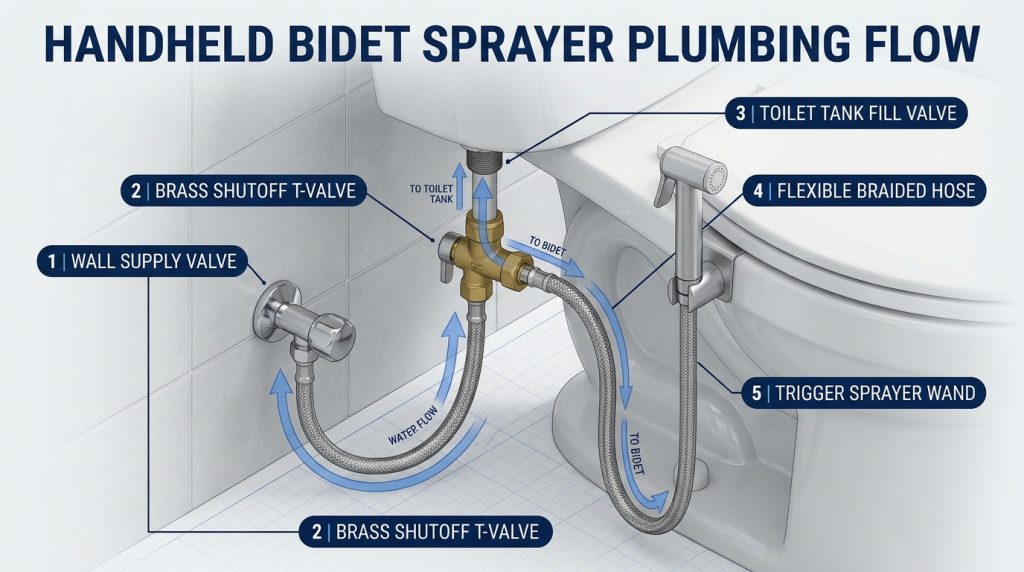
A handheld bidet sprayer consists of a high-pressure trigger nozzle connected to a 4-to-5-foot flexible stainless-steel hose, fed by a solid-brass T-adapter connected to your toilet’s water supply valve.
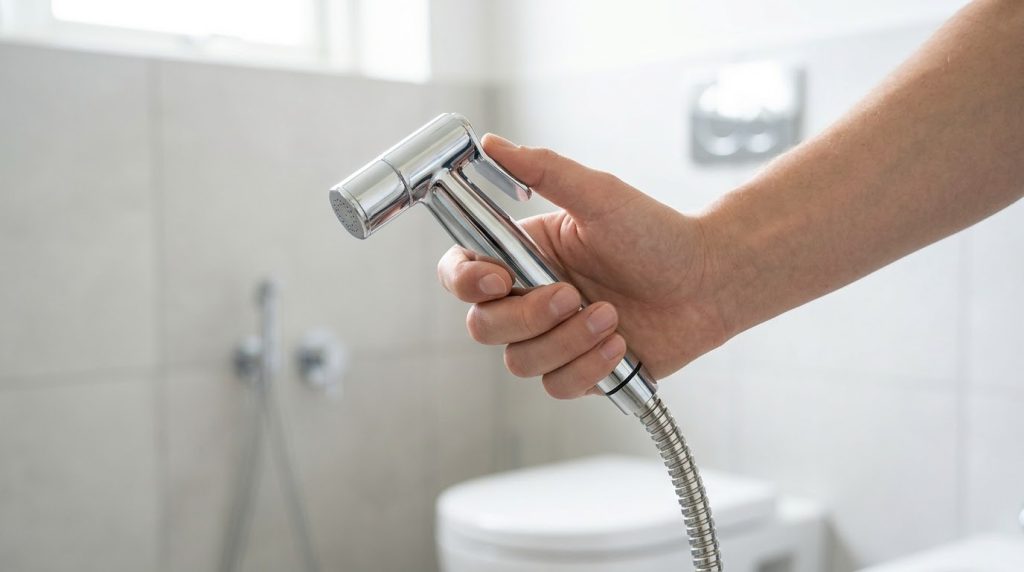
Widely used across Southeast Asia, Southern Europe, and the Middle East, the handheld sprayer gives you direct physical control over water placement, trajectory, and cleaning angle.
How a Bidet Sprayer Works Mechanically
The sprayer runs on household water line pressure. Pressing the spring-loaded thumb or finger trigger opens an internal ceramic disc or poppet valve, pushing water out of micro-perforated spray holes. Squeezing lightly yields a gentle rinse; depressing the lever completely unleashes a firm, high-velocity stream.
The sprayer connects to your home’s potable municipal supply line before it touches the toilet tank or bowl.
Top Benefits: Why Many Prefer Handheld Wands
- Unrestricted Aiming Freedom: Because you hold the wand, you can adjust the angle, distance, and direction of the water stream without having to shift your body across the toilet seat.
- Low Initial Investment: Quality all-brass spray kits cost under $50, making them an accessible option when evaluating a bidet cost.
- Zero Electricity Required: Operates entirely without power cords, backup batteries, or nearby electrical outlets.
Multipurpose Cleaning Utility
Unlike bidet seats, which are dedicated solely to personal hygiene, a handheld sprayer functions as a utility wash-down tool:
- Rinsing reusable cloth diapers directly into the toilet bowl.
- Blasting stubborn residue off porcelain walls during routine cleaning.
- Rinsing muddy outdoor gear, shoes, or gardening tools over the bowl.
- Washing pets or filling mop buckets without lifting heavy pails into a sink.
Common Drawbacks and Limitations
- Physical Dexterity Required: Users must reach down into the toilet bowl area while managing the trigger, which can challenge individuals with wrist pain, tremors, or limited flexibility.
- Splash Risk: Pointing the nozzle at an improper angle can spray water onto the rim, seat, or bathroom floor.
- Ambient Cold Water: Standard kits connect only to the toilet’s cold supply line. If you live in an area with freezing winters and wonder if this bidet water will bring out cold water, this answers your query. Unheated tap water can be a shock to sensitive skin.
- Manual Shutoff Discipline: there are proper ways to use a bidet sprayer. And one rules that governs it is that the brass T-valve must be closed after every use. Leaving the flexible hose under continuous municipal pressure can eventually cause hose ruptures and room flooding.
What Is a Bidet Toilet Seat?
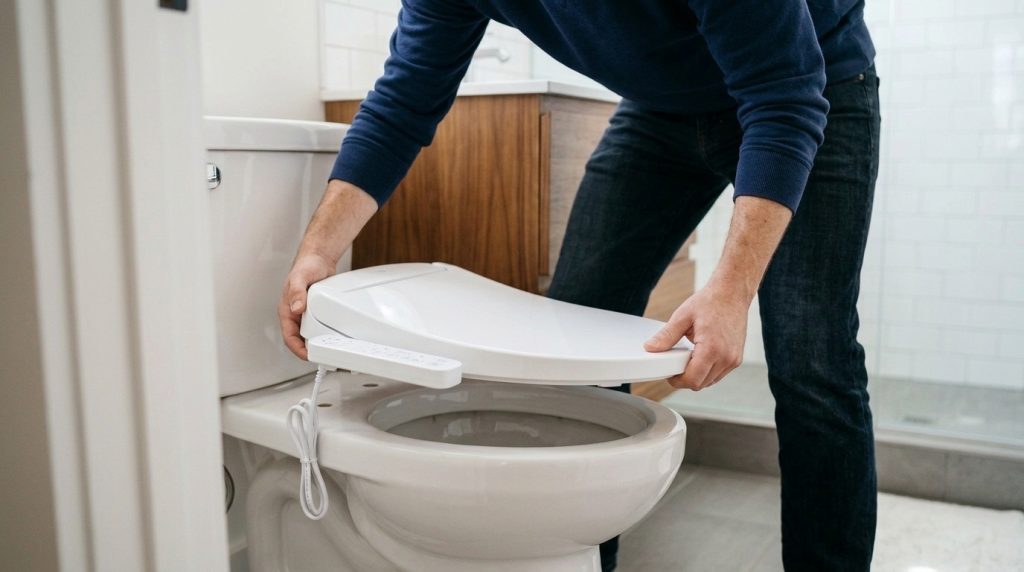
A bidet seat is an integrated, engineered plumbing fixture that completely replaces your factory plastic or wooden toilet seat and lid.
How an Electric Bidet Seat Works
Electric bidet seats use internal solenoids, micro-pumps, and ceramic core heating elements. When activated via a wireless remote control or side panel, an internal motorized wand extends from behind a protective housing, sprays a targeted stream, and retracts to undergo an automatic self-cleaning rinse.
When weighing an electric vs non-electric bidet ,the electric seat represents the pinnacle of residential personal hygiene technology.
Luxury Features That Sprayers Can’t Match
- On-Demand Instant Warm Water: Advanced ceramic heating coils warm incoming water instantaneously, providing continuous warm rinses without dropping in temperature.
- Heated Ergonomic Seating: Multi-stage heated seat rings eliminate the chill of cold porcelain during winter mornings.
- Hands-Free Warm-Air Drying: Built-in warm-air blowers direct gentle, temperature-controlled air across your skin, resolving how to dry off after using a bidet without toilet paper.
- Motorized Wand Customization: Using a remote, you can move the wand forward or backward, toggle oscillating sweeps, or activate pulsating pressure modes to stimulate bowel movements for constipation relief.
- Automatic Deodorization: An internal fan draws air through an active carbon filter cartridge to neutralize odors before they escape into the bathroom.
Key Drawbacks and Constraints
- High Initial Investment: Quality electric models range from $200 to over $650.
- Electrical Needs: Requires a dedicated 120V GFCI outlet located within 3 to 4 feet of the toilet.
- Bowl Sizing Constraints: Seats must be purchased to match the specific geometry of your bowl—either round (approx. 16.5 inches) or elongated (approx. 18.5 inches).
Ergonomics, Usability, and Cleaning Performance
Evaluating a bidet sprayer vs. bidet seat requires looking at how each fixture performs in everyday use.
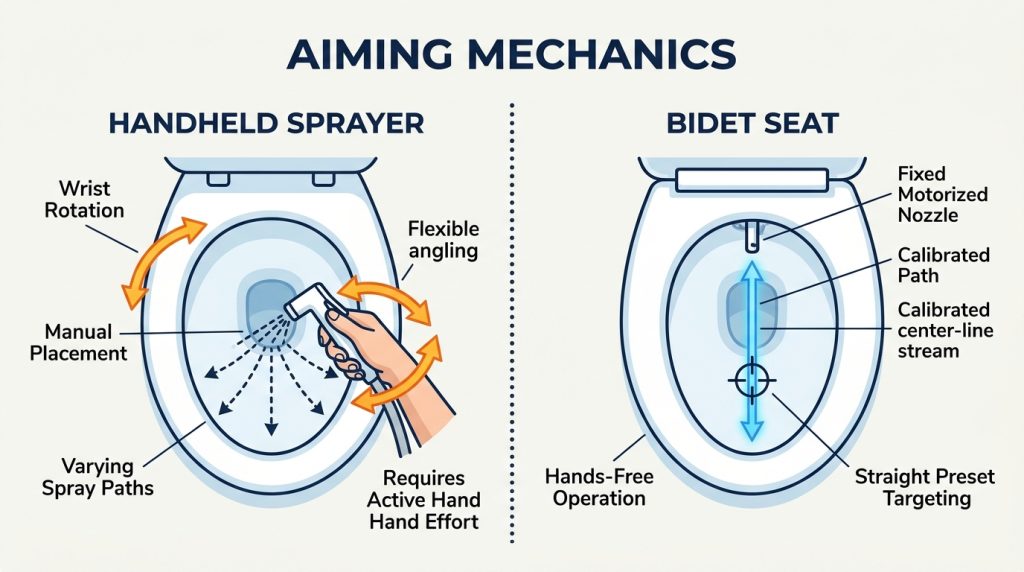
1. Precision Aiming: Manual Flexibility vs. Motorized Wands
- Sprayers: The user controls the exact spray angle, distance, and sweep pattern. This makes it easy to rinse specific areas without shifting your body on the seat.
- Seats: The nozzle extends along a fixed center line. While electric seats let you move the wand forward or backward with a remote, wider adjustments require shifting your posture on the seat.
2. Water Pressure Control
- Sprayers: Controlled via a hand trigger. Feathering the lever produces a gentle rinse, while a full squeeze delivers strong pressure. However, sudden line surges or an accidental full squeeze can release an uncomfortably harsh blast.
- Seats: Electric seats use internal electronic regulators and aerated micro-pumps to keep water pressure smooth, consistent, and predictable across multiple digital settings.
3. Splashback and Mess Control
- Sprayers: Sprayers carry a steeper learning curve. Pressing the trigger before the wand is positioned correctly inside the bowl can spray water onto clothing, the seat, or the floor.
- Seats: The spray angle is calibrated to remain entirely within the bowl. Built-in seat occupancy sensors prevent the nozzle from firing unless an adult is seated, eliminating accidental misfires.
4. Feminine Hygiene and Front Cleansing
Ensuring proper bidet feminine hygiene is critical when evaluating personal care fixtures. This means always washing strictly from front to back to prevent transferring bacteria toward the urethra:
- Sprayers: The user must carefully maneuver the wand to maintain a front-to-back washing angle. Bringing the spray head in from the rear at an improper angle can push rinse water forward, increasing the risk of bacterial contamination.
- Electric Seats: Dedicated “Feminine” wash buttons extend a second nozzle aperture further forward at an upward angle, delivering a wider, softer stream specifically designed for front cleansing during menstruation, pregnancy, or postpartum care.
Temperature Control and Heating: Instant Comfort vs. Ambient Cold
Water temperature plays a major role in comfort, particularly in cooler climates:
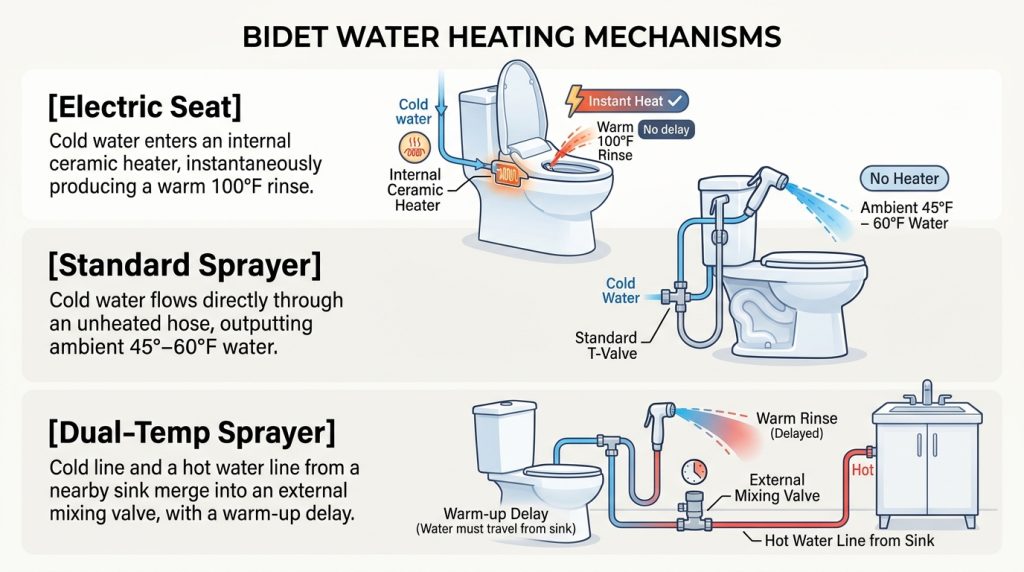
Electric Bidet Seats: Consistent, Regulated Warmth
Modern electric seats feature on-demand, tankless water heating systems. Incoming cold water passes through a high-efficiency ceramic cylinder, warming instantly to your chosen setting (typically 90°F to 104°F). Temperature sensors monitor the flow continuously, preventing sudden spikes or icy drops.
Handheld Sprayers and Ambient Water
Standard bidet sprayers connect exclusively to the toilet’s cold-water shutoff valve. In southern regions, ambient water remains temperate year-round. However, in northern climates during winter, municipal supply pipes can drop below 45°F (7°C), making unheated rinses uncomfortable.
While hot-and-cold mixing valves are available for handheld sprayers, they require running an auxiliary flexible hose to the hot-water shutoff under your bathroom vanity sink. This requires you to run the sink faucet first to pull hot water from your water heater, and routing an exposed hose across the bathroom floor creates a potential tripping hazard.
Drying and Paper Elimination: Handheld vs. Automated Seats
Washing with water is only the first step; drying off comfortably is equally important:
The Handheld Sprayer Routine
Handheld sprayers offer no drying mechanism. After washing, you must choose between two approaches:
- Toilet Paper: Pat dry with 2 to 3 squares of toilet paper. However, damp skin can cause standard paper to pill, shred, or leave lint behind.
- Reusable Cloth Towels: Pat dry with dedicated, clean cotton washcloths. Following proper bidet towel etiquette means using each small towel once and dropping it into an adjacent hamper for hot-water laundering.
Built-In Warm-Air Dryers on Electric Seats
Electric bidet seats feature an integrated warm-air drying fan. When activated, an air vent opens beside the spray wand, circulating warm air across your skin for 1 to 3 minutes. While it takes slightly longer than towel drying, it provides a hands-free experience that eliminates the need for paper entirely.
Installation, Plumbing, and Electrical Requirements
Both options are manageable for DIY installation, and we have covered very detailed posts on how to install a bidet attachment and how to install a bidet seat. But here is a quick rundown:
Installing a Handheld Bidet Sprayer
- Shut off the toilet water supply valve at the wall and flush the tank to relieve line pressure.
- Disconnect the flexible fill hose from the base of the toilet tank.
- Thread a solid-brass 7/8-inch T-valve onto the bottom of the tank shank.
- Reconnect the toilet fill hose to the bottom of the T-adapter, and attach the flexible bidet sprayer hose to the side outlet.
- Mount the sprayer holster bracket using the included tank-clip hanger or screw it directly into a nearby wall stud with drywall anchors.
- Check for leaks, open the main supply, and test the trigger operation.
Installing a Bidet Toilet Seat
- Measure the distance between your toilet’s mounting bolt holes (standard 5.5 inches) and from the bolt holes to the front of the rim:
- Remove your existing toilet seat and clean the porcelain mounting surface.
- Secure the sliding bidet mounting bracket over the bolt holes using the included rubber expansion bolts and metal washers.
- Slide the bidet seat onto the bracket until it clicks firmly into place.
- Install the included 7/8-inch T-adapter at the base of the toilet tank and connect the reinforced supply hose to the bidet inlet.
- For electric models, plug the three-prong power cord into a 120V GFCI-protected outlet.
Electrical and Safety Compliance
Under the certain codes, all bathroom electrical receptacles must provide Ground-Fault Circuit Interrupter (GFCI) protection. Running extension cords across a bathroom floor is unsafe and violates electrical safety standards. If your toilet area lacks a nearby outlet, you will need to have a licensed electrician install a dedicated GFCI outlet.
Safety, Leak Prevention, and Flood Risks
Plumbing leaks can cause costly structural damage. Understanding how each fixture manages line pressure is essential for protecting your home.
The Critical “Shutoff Rule” for Handheld Bidet Sprayers
The flexible rubber or braided hose on a handheld bidet sprayer is designed to handle dynamic water pressure while spraying, not continuous static line pressure.
If you leave the brass T-valve turned on constantly, household water pressure (typically 40 to 80 PSI) presses against the internal rubber hose and wand seals 24 hours a day. Over time, normal pressure surges can cause the hose to bulge, degrade, and rupture, leading to bathroom flooding.
Rule of Thumb: You must open the T-valve before using a handheld sprayer and shut it off immediately when finished. If your household includes children or guests who may forget this step, a bidet seat is a safer option.
Solenoid Protection in Bidet Seats
Bidet seats handle line pressure differently. Their reinforced supply lines connect directly to an internal, commercial-grade electric solenoid valve inside the rigid plastic chassis. The solenoid remains closed until a user sits on the seat and presses a button. When the wash cycle ends, the valve closes automatically, eliminating the risk of unattended hose failure.
Health, Medical Benefits, and Environmental Impact
Both handheld sprayers and bidet seats offer substantial personal health and environmental benefits over dry wiping:
Relief for Hemorrhoids, Fissures, and Sensitive Skin
Repeated wiping with dry, bleached paper creates shearing friction against swollen vascular tissue, exacerbating inflammation, micro-tears, and pruritus ani (chronic perianal itching).
According to clinical guidance from the Mayo Clinic, avoiding dry toilet paper and using warm water to gently rinse the perianal area reduces direct mechanical trauma and soothes irritated skin. Furthermore, research synthesized by the Cleveland Clinic notes that non-abrasive water cleansing prevents the chemical irritation caused by fragrances, dyes, and lint left behind by standard paper products.
For acute conditions such as anal fissures, post-surgical recovery, or postpartum perineal trauma, the National Institute of Diabetes and Digestive and Kidney Diseases (NIDDK) highlights warm-water hydrotherapy as an effective non-pharmacological method to relax the pelvic floor musculature, relieve localized spasms, and promote blood flow essential for tissue repair.
2. Accessibility for Seniors and Limited Mobility
For elderly users, individuals recovering from surgery, or those living with arthritis, reaching and twisting to wipe with paper can be difficult or painful.
- Handheld sprayers require hand strength and manual maneuvering inside the bowl.
- Electric bidet seats, by contrast, feature push-button wireless remotes, auto-washing routines, and hands-free warm-air drying that restore bathroom independence.
3. Environmental and Resource Conservation
The environmental toll of single-use flushable paper is substantial:
- Drastic Reduction in Virtual Water and Energy: According to data from the World Wildlife Fund (WWF), paper processing is among the most resource-intensive manufacturing sectors. Manufacturing a single roll requires massive amounts of embedded water and energy for timber harvesting and chemical bleaching. A bidet wash uses just 0.1 to 0.15 gallons (roughly 400–600 mL) per use, vastly outpacing the resource efficiency of dry paper production.
- Preserving Old-Growth Forests: Independent reports from Greenpeace International show that tissue manufacturing drives the degradation of carbon-rich forests across North America and Scandinavia. Switching to water cleansing cuts household paper consumption by 75% to 100%, instantly curbing consumer demand on vulnerable woodland ecosystems.
Cost, Durability, and Long-Term Value
Evaluating the true cost of each option requires looking at upfront pricing, maintenance needs, and expected lifespan:
1. Purchase and Installation Costs
- Bidet Sprayers ($25 – $70): The most budget-friendly entry point. Everything required for installation is included in the box, with no need for professional plumbing or electrical work. You can absolutely install a bidet sprayer yourself.
- Bidet Seats ($80 – $650+): Non-electric seats cost between $80 and $140. Premium electric models with ceramic heaters and warm-air dryers range from $200 to $650+. If your bathroom lacks an outlet near the toilet, adding a GFCI receptacle typically costs $150 to $300. Also, you don’t need a plumber you can install the bidet seat yourself.
2. Durability and Replacement Lifespans
- Bidet Sprayers (Lifespan: 2 to 5 Years): Built from solid brass or stainless steel, spray wands are durable. However, flexible hoses and trigger rubber O-rings can wear out or develop minor leaks after a few years of frequent use. Replacement hoses and heads are inexpensive and easy to swap out.
- Bidet Seats (Lifespan: 6 to 10+ Years): High-end bidet seats from reputable manufacturers are engineered as long-term appliances. Most include removable inlet mesh filters that can be rinsed periodically to protect internal valves from hard-water mineral buildup.
Comprehensive Decision Guide: Which Should You Buy?
Here is a simple way to know your need.
Choose a Handheld Bidet Sprayer If:
- You are on a tight budget: You want high-pressure water hygiene for under $50.
- You need a multi-purpose tool: You plan to rinse cloth diapers, clean the toilet bowl, or wash pets.
- You want direct aiming control: You prefer holding and directing the spray wand manually rather than shifting on a seat.
- You have no outlet near the toilet: You want an unpowered mechanical setup that requires no electrical work.
- Your household can remember the shutoff rule: Everyone in your home will consistently close the T-valve after every use.
Choose a Bidet Toilet Seat If:
- You want warm water and heated seating: You live in a cold climate and refuse to spray cold tap water onto sensitive skin.
- You want hands-free warm-air drying: You want to eliminate toilet paper completely without using cloth towels.
- You are outfitting a bathroom for seniors or limited mobility: You need the convenience of wireless remotes, auto-washing, and hands-free hygiene.
- You want minimal leak risk: You prefer an internal solenoid valve that shuts off automatically after every use.
- You value clean aesthetics: You prefer a seamless, integrated seat over an exposed hose hanging beside the toilet tank.
Frequently Asked Questions
Can a bidet sprayer flood your bathroom?
Yes, if the T-valve is left open continuously. Handheld sprayer hoses are designed for dynamic spraying pressure, not constant static line pressure. If the shutoff valve remains open, household water pressure can eventually cause the hose or trigger seal to fail. Always close the brass T-valve after every use.
Do bidet sprayers spray cold water only?
Standard bidet sprayers draw water directly from the cold supply line feeding the toilet. While hot-and-cold mixing kits are available, they require running an exposed flexible hose to the hot water line under your sink vanity, which can create a tripping hazard across the floor.
Is a bidet sprayer cleaner than a bidet seat?
Both are hygienic because they use fresh, potable tap water. Sprayers keep the nozzle outside the bowl in a holster when not in use. However, electric bidet seats feature self-cleaning wands that automatically rinse themselves with fresh or electrolyzed water before and after every wash cycle.
Can you install a bidet seat on any toilet?
Most standard two-piece toilets accommodate bidet seats without issue. However, you must match your bowl’s shape (round or elongated). If you have a one-piece toilet with a severe “French curve” where the tank blends smoothly into the bowl, some bidet seat housings may not fit. Some dedicated bidet seats can fit it and in those cases, a handheld sprayer.
Which is easier for women to use: sprayer or seat?
Most women find electric bidet seats easier and more hygienic. Dedicated feminine wash buttons position the wand forward to spray from front to back, protecting the urethra from colon bacteria. Handheld sprayers require careful manual angling to ensure proper wash direction.
In the bidet sprayer vs. bidet seat comparison, both options offer a significant upgrade over dry toilet paper. If you need a versatile, budget-friendly tool for cloth diapers and personal rinsing, a handheld bidet sprayer is a dependable choice. If you want maximum comfort, warm water, heated seating, and automated hands-free drying, an electric bidet seat is the gold standard for your bathroom.