Switching to a bidet is supposed to feel like the ultimate hygiene upgrade, until an unexpected bout of itching, irritation, or discharge leaves you second-guessing your routine. If you’ve recently found yourself asking, can bidets cause yeast infections? you aren’t the only one wondering if your new fixture is to blame.
While water is gentler than abrasive toilet paper, improper habits can quietly disrupt your body’s delicate balance. From excessive pressure washing away good bacteria to lingering moisture creating a prime breeding ground for Candida, here is the truth about how bidets impact vaginal flora and how to protect yourself.
Can Bidets Cause Yeast Infections?
Can bidets cause yeast infections? There is no solid evidence that they do. The main risks come from habits: spraying inside the vagina, using scented soap, hot water, and leaving the area damp afterward. Used gently and dried well, a bidet is unlikely to cause yeast overgrowth.
The question comes up because yeast thrives in warm, wet places, and a bidet is a source of warm water. That logic sounds neat, but it misses how yeast infections start. Below you will find what causes them, what the studies on bidet users show, and the exact habits that protect you. If urinary infections are your bigger worry, our companion piece can bidets cause UTIs? covers that side.
What Actually Causes a Yeast Infection
A yeast infection is a balance problem, not a cleanliness problem. Candida is a fungus that normally lives in the body without trouble. The CDC says roughly 20% of women carry it with no symptoms, and that it overgrows when conditions in the vagina change. Healthy lactobacilli usually keep it in check, as Mayo Clinic explains.
The CDC’s risk factor list is short and clear:
- Current or recent antibiotics
- Pregnancy
- Hormonal changes, including birth control pills
- Diabetes
- A weakened immune system
The NHS adds that thrush tends to develop in warm, moist areas and that irritated or damaged skin can trigger it. Notice that none of these is “washing with water.” Being too clean is not the cause, but disturbing the bacterial balance or leaving skin irritated and damp can tip things over.

Can Bidets Cause Yeast Infections? What the Evidence Shows
No trial has randomly assigned people to bidets and counted yeast infections. The studies that exist are observational, so treat each as a clue, not a verdict.
The largest survey found no extra yeast infections
A one-year follow-up of 7,637 Japanese adults, published in Preventive Medicine Reports, tracked physician-diagnosed Candida vaginitis. It was diagnosed in 0.6% of habitual bidet users and 1.6% of non-users. After adjusting for other factors, the gap was not significant. In plain terms, bidet users did not get more yeast infections. The limits are real: self-reported data, a web-panel sample, and funding from a sanitary equipment trade group.
The same study found one signal worth noting. Self-reported symptoms of bacterial vaginitis were higher in habitual users, 1.2% against 0.8%. The authors called it possible but inconclusive, because the case numbers were small.
Vaginal bacteria may change with heavy use
A 2010 study of 268 women, linked habitual use to changes in vaginal flora. According to Healthline’s summary, lactobacilli were missing in 42.86% of habitual users and 8.77% of non-users. Since lactobacilli are what keep yeast in check, this is the one plausible path to trouble. It measured bacteria, not yeast infections, and it shows association only.
Pregnancy
Healthline also mentions a 2019 study in high-risk pregnancies that linked regular bidet use to earlier delivery. It gives no figures, and it is an association. If you are pregnant, ask your provider how to use one.
How a Bidet Could Contribute
The bidet is rarely the problem. The way it gets used is. These are the realistic routes:
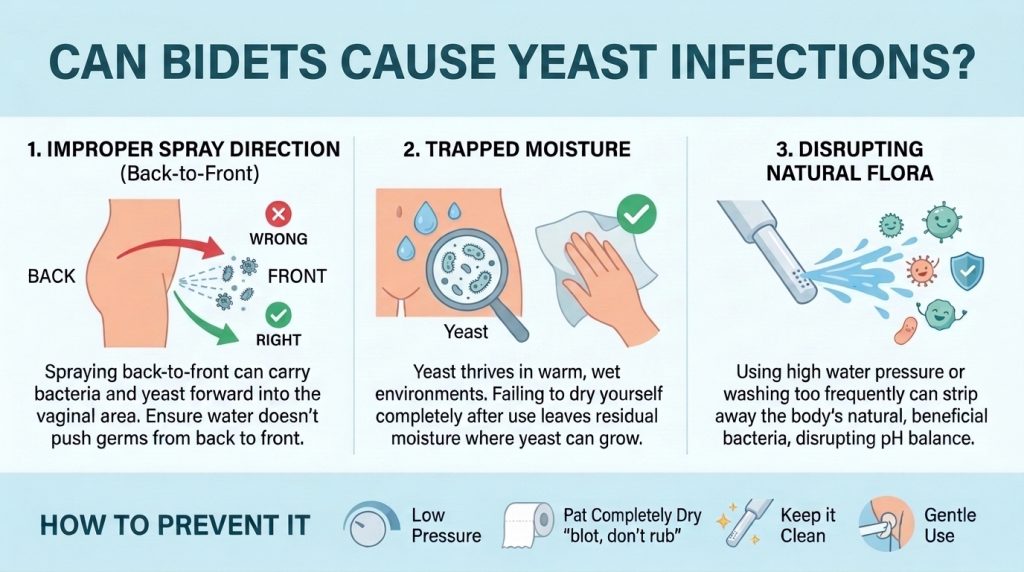
- Spraying inside the vagina. Mayo Clinic says to avoid douching, because it removes protective bacteria, and Medical News Today adds that the vagina cleans itself. A stream aimed inward works like a douche. However, a bidet and douching is not really same thing. We explains the line between the two.
- Soap and scented products. The NHS suggests using water and an emollient rather than soap, and Mayo lists scented soaps, pads and bubble baths as triggers to avoid. Our guide on using a soap with bidets, covers what is safe.
- Hot water. Using blazing hot water on the vagina among the things to avoid. Keep your bidet water warm, never hot.
- Staying damp. It’s best to dry the area thoroughly after washing, and it’s advised to change out of wet clothes promptly. Pulling underwear up over a wet area is probably the likeliest way a bidet could help yeast along.
- Washing too often or too long. Frequent, extended washes may unsettle the bacterial balance. Short and gentle is the goal.
- A dirty nozzle. Scale and residue build up. If you use both nozzles, rinse the front first and the rear last, as the front wash and a rear wash differs. In total, a bidet nozzle needs to be properly taken care of to avoid germs transfer.
Why a Bidet Can Be Gentler Than Wiping
The NHS lists irritated or damaged skin as a thrush trigger. Dry paper is a common source of both. Repeated wiping scrapes sensitive skin, and scented or “flushable” wipes add chemicals. Water has neither problem. A low-pressure rinse, followed by a pat dry with a bidet towel, treats the skin more kindly. If you’re still comparing between a bidet and toilet paper to classify each benefits.
If your skin is sore from wiping, a bidet is arguably the lower-risk option, as long as you follow the right bidet hygiene routines and also a right bidet towel etiquette.
How to Use a Bidet to Protect Against Yeast Infections
As a woman it’s best to use a bidet correctly to protect yourself from yeast infection. Incorrect use of it can promote instead of countering it. These are the points that protect the balance.
- Rinse the outside only. Never aim into the vagina or hold the stream there.
- Warm water, low pressure, short time. A few seconds is enough for most rinses.
- Plain water first. If you add soap, make it mild and unscented, on the outer skin only, and rinse it off.
- Dry thoroughly. This step matters most for yeast. Pat with a clean towel or paper, or air dry for a minute before dressing. Some people might feel there’s no need to dry up after using a bidet. However, you don’t want a moist vagina. It’s a breeding ground for yeast infection.
- Wear cotton and change out of wet clothes. Both Mayo Clinic and the CDC point to cotton underwear.
- Keep the nozzle clean. This is unnegotiable, you must properly deep clean your nozzle
If you notice itching or discomfort after you start using a bidet, stop for a few days and see whether it settles. Pressure that is too high and water that is too hot are the usual suspects.
Who Should Take Extra Care
Some people are already closer to the tipping point. If this is you, keep rinses gentle and talk to your clinician.
- Recurrent infections. The NHS says to see a GP if thrush returns more than four times in 12 months.
- Recent antibiotics. They kill protective bacteria too, which is why the CDC lists them as a risk factor.
- Pregnancy. Hormones raise the risk, and the NHS advises seeing a GP if you are pregnant or breastfeeding. Ask your provider about bidet use.
- Diabetes or a weak immune system. Both raise the risk on their own.
- After childbirth. Boston Medical Center says to rinse with warm water, pat dry and not wash inside the vagina. See its perineal care advice.
- Men. Thrush is possible in men too, with irritation around the head of the penis or under the foreskin, per the NHS. Dry carefully and use a bidet properly as a man.
Yeast Infection Symptoms and When to See a Doctor
The usual signs are itching and irritation, burning during sex or urination, redness, and thick white discharge that looks like cottage cheese and has little smell. Symptoms overlap with other infections, so the CDC says to see a provider to confirm the diagnosis, especially the first time. Do it again if you are unsure, if over-the-counter treatment fails, or if symptoms keep coming back. The NHS advises not using antifungal medicine more than twice in six months without asking a pharmacist or doctor. Never assume the bidet is the cause without a check.
Frequently Asked Questions
Is a bidet better than toilet paper for preventing yeast infections?
Nothing proves either one prevents them. A bidet is gentler on the skin, which helps, but only if you dry well afterward. Dampness cancels the benefit.
Can I use a bidet during a yeast infection?
A gentle external rinse with warm water at low pressure is generally fine, but don’t aim at sore skin with force or spray inside. Ask your provider if you are unsure, and follow your treatment instructions.
Can bidets cause bacterial vaginosis?
The survey above found more self-reported bacterial vaginitis symptoms in habitual users, but the authors called it inconclusive because of small numbers. Other research found fewer lactobacilli among heavy users. Keep washes short and external.
Does the order of nozzles matter?
Yes. Rinse front first, rear last, so you do not carry bacteria forward. Our guide on the good bidet for women specifies the ones that covers dual-nozzle models.
Final Thoughts
Can bidets cause yeast infections? There is no evidence that they do, and the best survey found no extra yeast infections among regular users. The real risks are spraying inside, scented products, hot water, overuse and staying damp. Keep it external, warm, gentle and short, dry well, and see a doctor if symptoms start.