Modern bathroom technology has transformed the classic bidet from a humble cold-water basin into an advanced smart home appliance. Today’s electronic bidet seats and integrated smart toilets pack miniature water heaters, centrifugal fans, catalytic carbon filters, wireless transceivers, and microprocessors beneath an ergonomic plastic chassis.
Yet, evaluating modern bidet features can quickly feel overwhelming. With product sheets boasting terms like “electrolyzed water pre-misting,” “positive temperature coefficient dryers,” and “continuous ceramic heating coils,” buyers often struggle to separate essential personal hygiene tools from marketing fluff.
Understanding which bidet features genuinely improve your daily routine is the key to choosing the right fixture for your home.
Bidet Features Explained: Heated Seats, Dryers, Deodorizers, and Controls
Bidet features are built-in mechanical and electronic functions designed to elevate personal hygiene and comfort beyond basic toilet paper. Ranging from temperature-controlled heated seats and warm-air dryers to active carbon deodorizers and customizable wireless remotes, these capabilities transform an ordinary toilet into an automated, hands-free personal care station tailored to your daily routine.
They inculde:
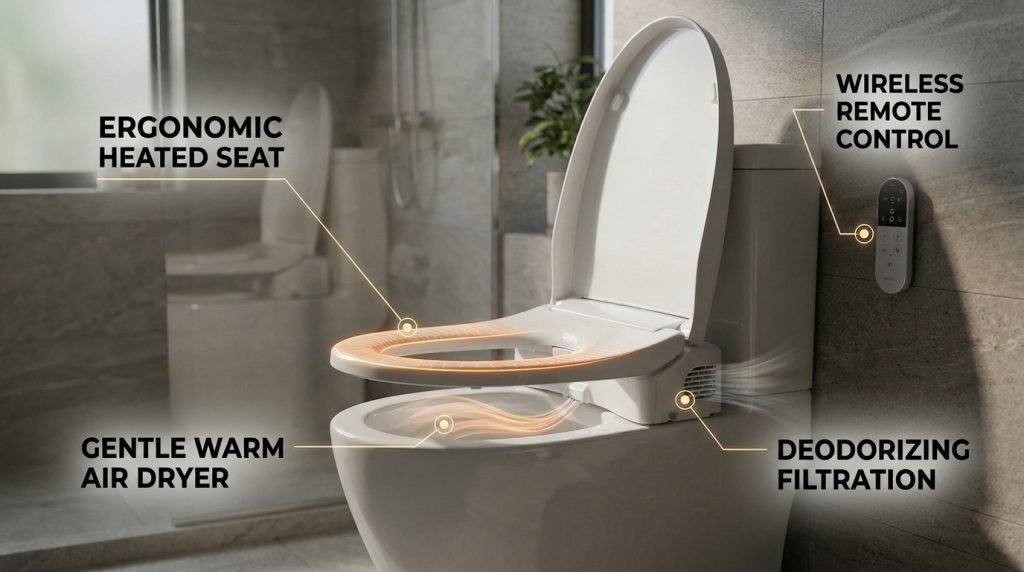
Heated Seats: Embedded resistive wire grids warm the seat surface to an adjustable 90°F to 104°F, using capacitive sensors to prevent thermal skin burns.
Warm-Air Dryers: Internal positive temperature coefficient (PTC) heating coils and centrifugal blowers circulate gentle warm air to dry delicate skin without paper friction.
Deodorizers: Miniature vacuum fans draw bowl air through an active catalytic carbon filter, chemically neutralizing odors before they leave the porcelain bowl.
Controls: Interfaces range from budget-friendly side-mounted arm consoles to wall-mounted wireless RF remotes and smartphone apps with personalized wash profiles.
Heated Bidet Seats Feature
For anyone living in cold winter regions or getting up for early-morning bathroom trips, a heated seat is often the single feature that turns a skeptic into a lifelong convert.
How Heated Bidet Seats Work Mechanically
A heated bidet seat does not blow hot air under your thighs. Instead, engineers weave an insulated, resistive electrical heating wire grid throughout the hollow interior of the contoured polypropylene or ABS plastic ring.
When you activate the heating function, electric current flows through this resistive filament, generating radiant thermal energy. Embedded electronic thermistors continuously monitor the surface temperature of the plastic, feeding real-time data back to the seat’s central logic board. Once the target temperature is reached, the circuit pulses power to maintain consistent warmth without overheating.
Temperature Settings and Thermal Comfort
Most smart bidets offer three to five adjustable temperature settings:
- Low: 90°F (32°C) – Barely warm, ideal for mild spring/fall days.
- Medium: 95°F (35°C) – Matches average surface skin temperature, feeling neutral and cozy.
- High: 100°F – 104°F (38°C – 40°C) – Distinctly warm and therapeutic for freezing winter mornings.
Beyond everyday comfort, mild local heat provides clinical benefits. Radiating warmth helps soothe hyperactive pelvic floor muscles, easing conditions like chronic pelvic pain or muscle tightness during bowel movements.
Energy Consumption and Smart Eco-Modes
A heated seat is the primary continuous power draw on an electric bidet. Left on high 24 hours a day, a heated ring draws roughly 40 to 60 watts continuously, adding $3.00 to $5.00 to your monthly electric bill.
To curb unnecessary energy use, manufacturers incorporate two types of eco-modes:
- Timer-Based Eco Mode: Keeps the seat heater turned off or at low idle for 6 to 9 hours during times you are typically asleep or away at work.
- Smart Learning Mode: An internal algorithm tracks the times of day the bathroom is frequented over a 10-day period. The seat then lowers power during idle hours and warms up right before your anticipated morning and evening routines.
Safety Protections: Preventing Low-Temperature Burns
Sitting on a heated surface for extended periods can theoretically cause erythema ab igne; a localized skin discoloration caused by prolonged mild heat exposure. To protect users, quality bidets incorporate a capacitive seat occupancy sensor.
If a user remains seated for longer than 10 to 15 minutes, the logic controller automatically steps the seat temperature down to its lowest setting, preventing skin redness or burns.
Warm-Air Dryers Feature
The warm-air dryer bidet feature is the feature designed to make your bathroom completely paper-free. But how does it hold up in everyday practice?
How Bidet Dryers Work
Positioned inside the rear housing of the seat next to the spray wand sits an electric heating element paired with a small, ultra-quiet centrifugal squirrel-cage blower fan.
Most modern bidets use PTC (Positive Temperature Coefficient) ceramic heating stones. PTC ceramics self-regulate their temperature: as they heat up, their electrical resistance increases, preventing runaway overheating and ensuring steady thermal output. When you tap the “Dry” button, motorized louvers open, the heating element warms, and the blower pushes a gentle stream of warm air (ranging from 95°F to 135°F) directly across the perianal area.
Drying Time vs. Reality: Does It Truly Replace Toilet Paper?
Marketing materials frequently claim bidet dryers allow you to eliminate toilet paper entirely. In practice, this depends on how much patience you have:
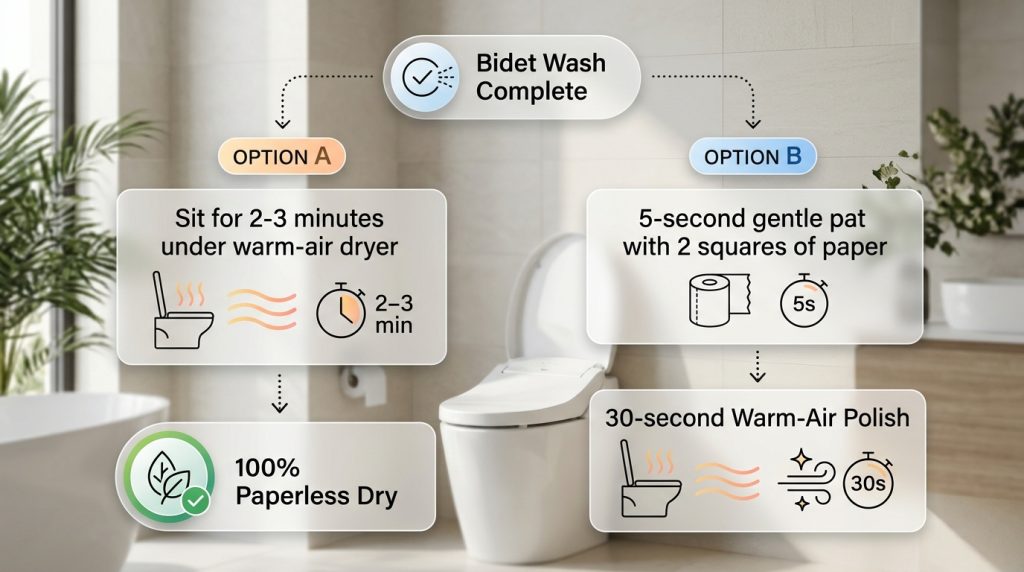
A bidet dryer operates like a gentle hair dryer. Because human skin has natural contours and moisture clings, completely air-drying from soaking wet takes between 2 and 3 full minutes.
Many users prefer a hybrid approach: they use two squares of toilet paper or a reusable cotton towel to pat away excess surface water, then run the warm-air dryer for 30 to 45 seconds to finish drying. This prevents paper pilling, avoids skin friction, and reduces household paper consumption by over 80%.
Clinical Value for Irritated Skin
For individuals suffering from acute hemorrhoids, anal fissures, or recovering from perineal tears after childbirth, physical friction from toilet paper can cause significant pain and micro-tears.
Warm-air drying eliminates tactile contact altogether, drying irritated skin through non-abrasive airflow. Furthermore, keeping the perianal region clean and dry discourages the growth of fungal and bacterial infections responsible for chronic pruritus ani (perianal itching).
Automatic Deodorizers Feature
A common misconception among first-time bidet shoppers is assuming that an “automatic deodorizer” sprays artificial perfumes or aerosol scents into the room. It does not.
How Bidet Deodorizers Work Mechanically
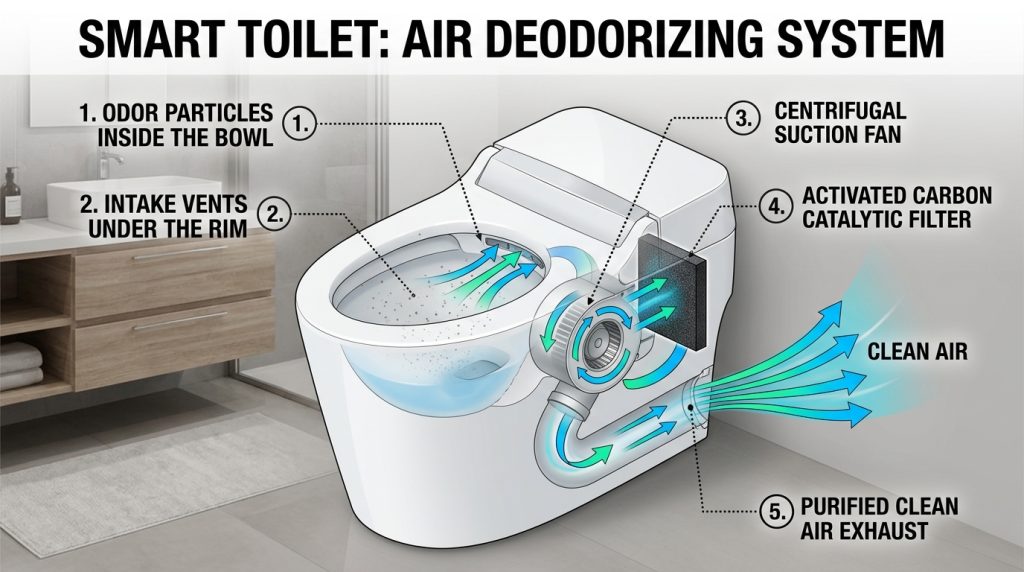
A bidet deodorizer is an in-bowl, mechanical air-filtration system:
- Intake Vent: Molded intake louvers sit directly beneath the rear rim of the toilet seat, positioned inches above the water line.
- Suction Fan: As soon as the occupancy sensor detects a user sitting down, a compact, whisper-quiet micro-fan switches on. This creates negative air pressure inside the toilet bowl, pulling ambient bowl air into the filtration duct before it can rise into the bathroom.
- Active Carbon Honeycomb Filter: The air is drawn through an extruded ceramic honeycomb block coated in powdered activated carbon (charcoal).
The Science of Catalytic Carbon Adsorption
Activated carbon is processed to have micro-pores, giving it an enormous internal surface area (roughly 1,000 square meters per single gram of carbon).
As odorous volatile organic compounds, primarily hydrogen sulfide (rotten egg odor) and methanethiol (pungent sulfur compounds), pass through the filter matrix, chemical adsorption occurs. The gas molecules bond to the porous carbon surface, neutralizing the smell at the source. The exhausted air that exits the side of the seat is clean and odor-free.
Maintenance, Cleaning, and Lifespan
Unlike whole-room ceiling fans that attempt to clear air after odors have already filled the room, an in-bowl deodorizer catches smells at the point of origin.
- Cleaning: Every 3 to 6 months, users should pull the small carbon filter drawer out from the side of the seat and vacuum away surface lint and dust.
- Replacement: The catalytic carbon block lasts between 3 and 5 years before its adsorption pores become fully saturated. Replacement filter cartridges generally cost between $15 and $25 and take 30 seconds to swap out.
Bidet Controls Features (Remote Controls vs. Side Panels)
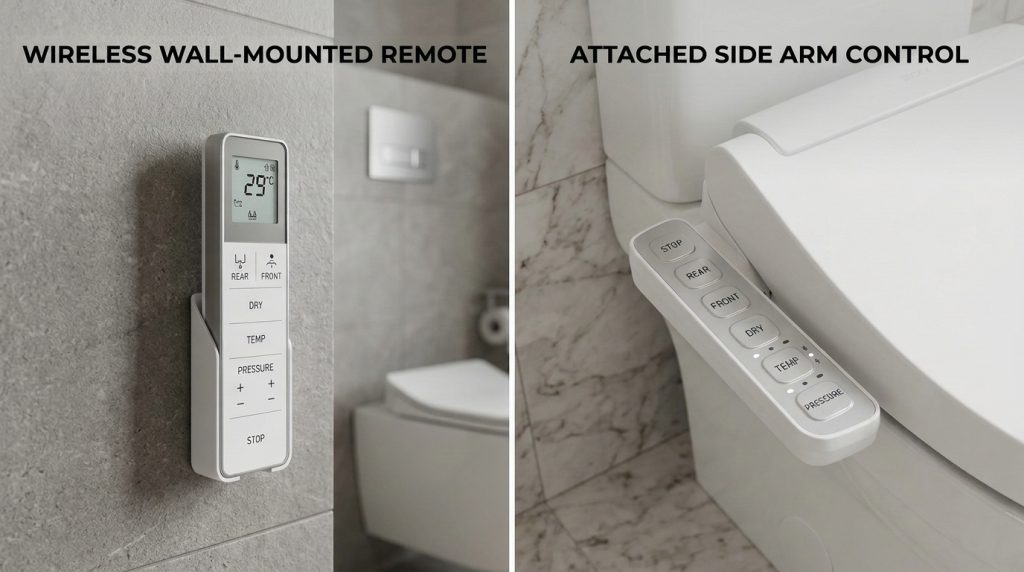
How you interact with your bidet dictates your day-to-day satisfaction. Bidet controls generally fall into two categories: tethered side panels and wireless remote controls.
Side-Mounted Control Panels: Pros and Cons
Side panels are rigid control arms permanently attached to the right side of the bidet seat.
- The Advantages: They are cost-effective (saving $50 to $150 compared to remote models), impossible to drop or lose, and require no separate batteries since they draw power directly from the seat’s cord.
- The Drawbacks: The control panel sits beside your hip. To see the buttons, you must twist your torso, crane your neck downward, and look past your thigh. For users with larger body frames, restricted spine mobility, or arthritis, operating a side panel can be physically challenging. In smaller bathrooms, the panel can also bump against an adjacent vanity or wall.
Wireless Remote Controls: Ergonomics and Usability
Wireless remotes communicate with the seat via high-frequency Radio Frequency (RF) or Infrared (IR) signals:
- Mounting Flexibility: Remotes come with a magnetic docking plate that screws or sticks with adhesive tape to the adjacent bathroom wall at eye level.
- User Interfaces: Mid-to-high-tier remotes feature large push buttons, intuitive icons, and back-lit LCD screens displaying exact water temperature levels, pressure bars, and wand positions.
- User Memory Profiles: Flagship remotes include dedicated “User 1” and “User 2” memory presets. With a single tap, the seat recalls your preferred water pressure, wand angle, spray temperature, and dryer settings, eliminating the need to reconfigure controls every time you sit down.
Universal Design and Accessibility
For seniors aging in place, individuals recovering from joint surgery, or family members with limited mobility, wireless remotes offer valuable independence. Placing the remote within easy arm’s reach allows complete control without uncomfortable twisting, reaching, or bending.
Water Heating Mechanisms Features (Tank vs. Tankless)
Another features people do compare is the tankless vs tankless features. Every other comfort feature relies on one core capability: how the bidet warms its water.
1. Reservoir Tank Water Heaters
Older and entry-level electric bidets store roughly 20 to 30 ounces of water in a small internal heated tank.
- The Good: Inexpensive to manufacture and provides consistent warmth the moment the wand activates.
- The Bad: Limited supply. After 30 to 45 seconds of continuous spraying, the tank runs out of warm water and the stream turns cold. The bidet then takes 3 to 5 minutes to heat a fresh batch of water. Additionally, the physical tank requires a bulkier, raised rear housing, which reduces usable sitting area on compact toilets.
2. Instantaneous (Tankless) Ceramic Heaters
Modern premium bidets route incoming cold municipal water through a high-efficiency ceramic cylindrical heating element that warms water on demand in fractions of a second.
- The Good: Truly endless warm water. Whether you wash for 30 seconds or 3 minutes, the water temperature never drops. Because there is no storage tank, the rear housing of the seat is noticeably slimmer, flatter, and more aesthetic.
- The Bad: Requires higher peak electrical draw (up to 1,400 watts while the wand is spraying), requiring a stable, dedicated electrical circuit.
Mechanical Features
Spray Wand Feature: Stainless Steel vs. Antimicrobial Plastic Wands
The spray wand is the mechanical heart of any bidet.
- Composite Antimicrobial Plastic: Common in Japanese-manufactured units (like Toto Washlets). High-grade polypropylene is infused with silver ions or antimicrobial additives to inhibit bacterial growth. The seamless, one-piece construction prevents grit from catching on exterior joints.
- Solid Stainless Steel: Favored by many modern brands for durability. Stainless steel is non-porous, highly resistant to mineral deposits and corrosion, and cleans easily. Some designs use an internal plastic water core encased in a stainless-steel exterior sleeve.
Wash Mode Variations Explained
Beyond simple forward and backward adjustments, advanced bidets offer several specialized wash patterns:
- Posterior Wash: A focused, firm central stream designed for standard bowel-movement cleansing.
- Feminine Wash: There are some specific bidet with female features. Their wands extends further forward, opening a separate spray hole that aerates the stream infusing tiny air bubbles into the water, to deliver a wider, gentler rinse for the sensitive vulva and perineal region.
- Oscillating Mode: The motorized wand glides back and forth in continuous sweeps, expanding cleaning coverage without requiring the user to shift on the seat.
- Pulsating / Massage Mode: Rapidly alternates water pressure between high and low bursts, stimulating blood circulation and helping relax sphincter muscles.
- Turbo / Intensive Wash: A narrow, high-pressure, un-aerated jet focused to help relieve chronic constipation.
Nozzle Self-Cleaning and UV Sterilization
High-end bidets keep their wands clean through automatic sanitizing cycles:
- Pre- and Post-Rinsing: The wand remains inside its housing while fresh water cascades over its outer surface before extending and immediately after retracting.
- Electrolyzed Water (eWater+): Incoming tap water passes through an internal electrolytic chamber that converts chlorine ions into hypochlorous acid, a safe, natural disinfectant mist that rinses the wand and bowl, breaking down microscopic bacteria before reverting back to ordinary water.
- UV-C Radiation: Integrated ultraviolet light emitters shine germicidal UV-C light directly onto the retracted wand tip, neutralizing bacterial DNA inside the nozzle chamber.
Other Automation and Sensor Features on Premium Bidets
Top-tier bidet models eliminate nearly all manual contact, using integrated sensors to streamline your routine:
- Motion-Activated Lids: Ultrasonic or radar sensors detect when you walk into the bathroom, automatically raising the lid. Stepping away closes the lid and seat automatically, keeping hands free from bathroom surfaces.
- Automatic Departure Flushing: Using an internal motor connected to the flush mechanism, the bidet flushes itself 3 to 5 seconds after you stand up, differentiating between a small flush (liquid waste) and a large flush (solid waste) based on how long you were seated.
- LED Nightlights: Soft, ambient LED lights illuminate the inside of the toilet bowl with a gentle glow, allowing nighttime visits without turning on harsh, wakefulness-inducing overhead lights.
- Pre-Misting: As soon as a user sits down, the bidet sprays a fine mist of water across the dry ceramic bowl. Wet ceramic is significantly more slick than dry porcelain, reducing waste adhesion by up to 80% and keeping the bowl cleaner between scrubbings.
Which Features Do You Actually Need?
To help match features to your budget, smart bidets generally fall into three price-to-feature tiers:
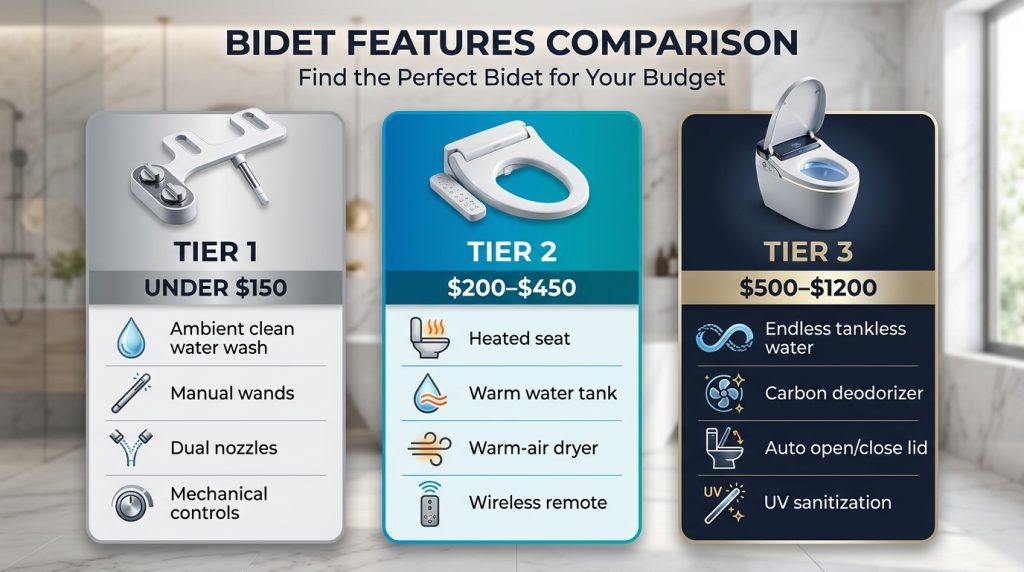
Tier 1: Essential Hygiene (Under $150)
- Who it’s for: These are mostly bidet attachments. They are suitable for renters, budget-conscious shoppers, or anyone testing water washing for the first time.
- What you get: Non-electric bidet seats or high-end mechanical attachments. You get clean-water cleansing, dual nozzles (front and rear), manual water pressure control, and a seat that sits flat on the porcelain rim. Water is ambient cold, and drying is handled with toilet paper or a cloth towel.
Tier 2: Everyday Comfort ($200 – $450)
- Who it’s for: Mostly bidet seats. suitable for homeowners wanting dependable comfort and cold-weather warmth without paying for luxury automation.
- What you get: The sweet spot of value. Includes a thermostatically heated seat, continuous or reservoir warm water, a multi-speed warm-air dryer, oscillating wash modes, and a wall-mounted wireless remote control with intuitive push buttons.
Tier 3: Luxury and Complete Automation ($500 – $1,200+)
- Who it’s for: Mostly smart bidets or integrated bidet or all-in-one bidets. These are smart home enthusiasts, modern bathroom renovations, or households outfitting a bathroom for aging-in-place seniors.
- What you get: Instantaneous tankless ceramic water heating (endless warmth), active carbon catalytic deodorization, hands-free auto-opening/closing lids, automated bowl pre-misting, eWater+ or UV-C nozzle sterilization, programmable user presets, and LED bowl nightlights.
Frequently Asked Questions
Does a heated bidet seat use a lot of electricity?
No. While instant water heaters draw 1,200 to 1,400 watts during an active 60-second wash, they spend most of their time in idle standby. When using built-in eco-modes, a modern electric bidet seat consumes between 15 and 30 kilowatt-hours per month—adding only $2.00 to $4.50 to your monthly utility bill.
Can you turn off the heated seat and warm-air dryer in the summer?
Yes. Every electronic bidet seat allows you to adjust or completely shut off the seat heater and water heater. During warm summer months, you can tap the seat temperature button until the indicator light turns off, running the seat at ambient room temperature to save power.
How long does it take for a bidet dryer to completely dry you?
A warm-air dryer takes between 2 and 3 full minutes to dry skin completely from soaking wet. Most users prefer taking 5 seconds to gently pat away excess water with two squares of toilet paper or a reusable towel, then running the dryer for 30 seconds for a warm, comfortable finish.
Do bidet deodorizers actually work, or do they just mask smells?
They work exceptionally well because they use active charcoal adsorption rather than scented sprays. The intake fan creates negative air pressure inside the toilet bowl, pulling sulfur and ammonia molecules into an activated carbon matrix that neutralizes odors before they can rise into the bathroom.
What happens if the wireless remote control battery dies?
All quality bidet seats equipped with wireless remotes include a small auxiliary control button strip built directly onto the side of the seat base. These emergency buttons allow you to trigger a standard rear wash, front wash, and stop function even if your remote batteries are dead or misplaced.
Are smart bidet features safe to use around water?
Yes. Smart bidet seats are manufactured to strict international electrical safety standards (such as UL 1431 and CSA C22.2). Internal electronic circuit boards are fully potted in waterproof resin (rated IPX4 or higher to resist water splashes from any direction), and the units must plug into a GFCI-protected outlet that immediately cuts power if a ground fault occurs.
Can I upgrade from a basic bidet to one with advanced features?
Yes, upgrading is straightforward. If you currently use a non-electric attachment or handheld sprayer, you can easily replace it with a feature-packed electric bidet seat or an integrated smart toilet.
The main requirement is adding a dedicated 120V GFCI electrical outlet within 3 to 4 feet of your toilet to power advanced features like instant warm water, heated seating, warm-air dryers, and auto-deodorizers. Beyond confirming electrical access and measuring your bowl shape (round vs. elongated), swapping fixtures takes under 30 minutes using the existing cold-water line and shutoff valve.
Final Thoughts
Understanding modern bidet features allows you to look past marketing buzzwords and invest in what truly improves your daily bathroom routine. If your goal is simple cleanliness, basic water-delivery features will serve you well. But if you want a comfortable, spa-like experience, investing in a heated seat, instant warm water, an active deodorizer, and an ergonomic wireless remote makes every trip to the bathroom cleaner, easier, and far more comfortable.