
Washing with water is gentler, cleaner, and far more sanitary than dry toilet paper. While electronic bidet seats often dominate luxury bathroom discussions, millions of households across the globe rely on an entirely different, incredibly versatile tool: the spray wand.
If you have ever traveled through Southern Europe, the Middle East, or Southeast Asia, you have likely seen one mounted right beside the toilet tank. But what is a handheld bidet sprayer? how does it function? and why do so many homeowners prefer it over fixed seats or attachments?
Here is a practical, straightforward look at everything you need to know.
What Is a Handheld Bidet Sprayer?
A handheld bidet sprayer — often called a bidet shower or shattaf — is a manually operated, trigger-activated nozzle connected to a flexible hose that plumbs directly into your bathroom’s clean water line.
Instead of sitting on a fixed nozzle built into your toilet seat, you lift the sprayer out of a wall or tank holster, hold it inside the toilet bowl, and control the water stream manually by depressing a thumb trigger. It delivers targeted personal hygiene while doubling as a heavy-duty household rinse tool.
Key Components: How Does a Handheld Bidet Sprayer Work?
Understanding how a bidet works in a handheld setup comes down to three mechanical parts:
- The T-Valve Diverter: A solid metal adapter that threads between your wall shutoff valve and the bottom of your toilet tank. It splits your water line, sending water to both your toilet tank and the bidet hose. Just ensure your plumbing adapters are in line with the IAPMO plumbing standards in your state to ensure wash water cannot siphon backward into your home’s potable drinking supply under pressure changes.
- The Flexible Braided Hose: Usually 4 to 5 feet long, the hose consists of a high-tensile stainless steel exterior wrapped around an internal reinforced rubber or EPDM tube. High-quality hoses meet ASME flexible water connector guidelines to safely handle household water pressure.
- The Sprayer Wand and Trigger: Made from chrome-plated ABS or brushed stainless steel, the wand features a spring-loaded trigger valve. Pressing the trigger lightly releases a soft rinse; depressing it fully unleashes a strong, high-pressure jet.
Also, don’t worry all bidet sprayer comes with these parts in their kits.
The water flowing through the sprayer is the exact same potable, clean drinking tap water feeding your bathroom sink and shower—never water from the toilet bowl or tank.
What Is a Handheld Bidet Sprayer Used For?
While automated bidet seats serve a single purpose, a handheld sprayer functions as a multi-use utility wand:
- Personal Cleanliness: It allows you to direct water exactly where needed from any angle, making it an excellent hygiene tool. As a woman using a handheld bidet, bidet sprayers are also sanitary for women.
- Cloth Diaper Rinsing: It is widely considered the gold standard for parents who cloth diaper. You can spray solid waste directly into the toilet bowl before tossing diapers into the wash, eliminating manual scraping.
- Deep Bathroom Cleaning: The 4-foot reach lets you blast mineral scale off the toilet rim, rinse cleaning solutions from the bowl, or wash bathroom floor tiles and trash cans effortlessly.
- Therapeutic Relief: Clinical findings in a peer-reviewed study on PubMed show that gentle water washing helps lower anal resting pressure and relieves discomfort. For individuals managing swollen tissue, the American Society of Colon and Rectal Surgeons (ASCRS) recommends washing with water over dry paper to avoid painful friction.
Handheld Bidet Sprayer vs. Bidet Toilet Seat: Which Is Better?
When weighing an electric vs non-electric bidet, comparing a sprayer to a toilet seat highlights clear functional trade-offs:
| Feature | Handheld Bidet Sprayer | Bidet Toilet Seat |
| Typical Cost | $25 – $55 | $60 – $650+ |
| Aiming Control | 360° full manual positioning | Fixed motorized or mechanical track |
| Water Temperature | Ambient tap water (cold) | Instant heated (electric models) |
| Drying Options | Towel or paper pat-dry | Built-in warm-air dryer fan |
| Utility Cleaning | Diapers, pets, bowl rims | Strictly personal personal hygiene |
| Installation Space | Leaves existing seat untouched | Replaces current seat completely |
Why Choose a bidet Sprayer?
A sprayer gives you pinpoint aim. With a fixed seat, you must shift your body to catch the stream. With a sprayer, your hand directs the angle, making it easy to master using a bidet without making a mess. It also preserves your factory toilet seat and costs a fraction of an electric seat.
Why Choose a Seat?
Seats offer hands-free operation. Premium electric seats include heated seat rings, warm-air dryers — solving how to dry off after using a bidet without touching paper — and wireless remotes. Sprayers require manual holding and spraying, which may be difficult for users with severe arthritis.
Which Handheld Bidet Sprayer Is Best For Your Toilet?
Finding the right handheld sprayer depends on your plumbing, budget, and daily needs. While basic models handle everyday rinsing, premium stainless steel options offer precision pressure control, durable leak-free brass valves, and ergonomic triggers.
To help you pick the perfect match for your bathroom setup, explore our detailed guide to the best handheld bidet sprayers available today.
How to Use a Handheld Bidet as a Woman
Using a handheld bidet provides gentle, targeted hygiene, but technique matters. Always angle the wand to spray strictly from front to back to protect sensitive lady parts and prevent bacterial transfer.
Keep the water pressure low, rinse gently, and pat dry with toilet paper or a dedicated towel. For a full walkthrough, read our detailed guide on how to use a bidet hose as a woman.
Can You Get Warm Water With a Handheld Bidet Sprayer?
Most handheld units connect directly to the cold-water fill valve behind your toilet. If you live in a cold climate, this might be a concern to you when using a bidet sprayer.
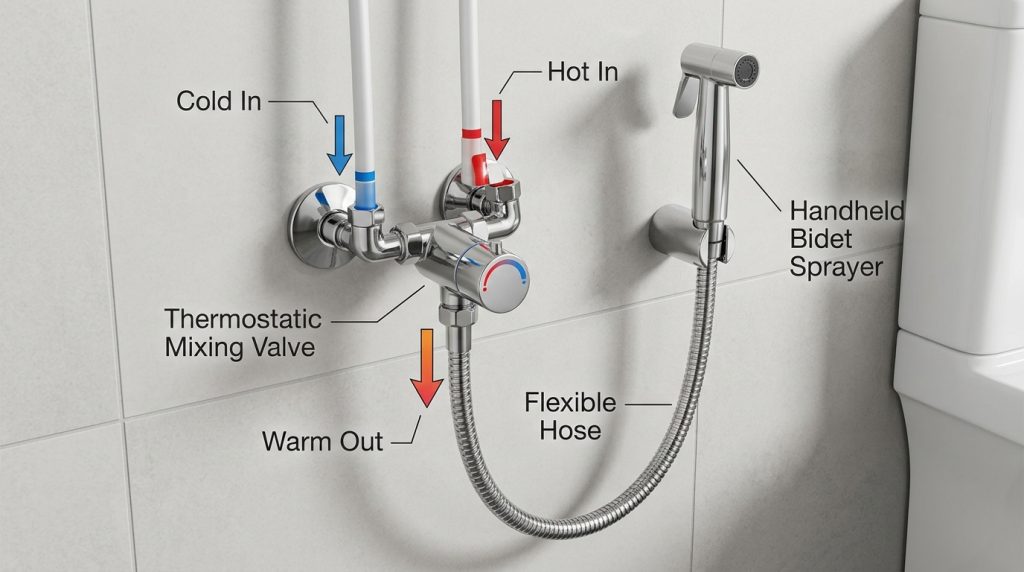
While standard setups spray ambient water, you can get warm water by installing a dual-line thermostatic mixing valve.
A mixing valve connects under your nearby bathroom sink, drawing from both the hot and cold supply lines. A slim flexible line then runs from under the vanity to your sprayer. While effective, keep in mind that you must wait a few seconds for the hot water to reach the sink, and the external tube connecting your vanity to the toilet must be routed neatly to avoid clutter.
Critical Safety & Maintenance: The T-Valve Rule
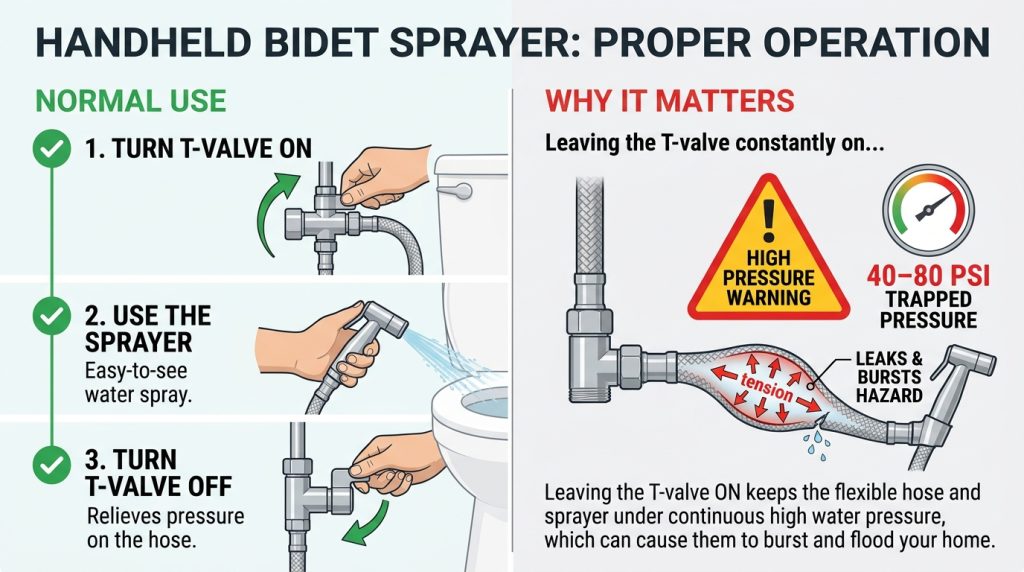
If there is one non-negotiable rule when using a handheld sprayer, it is this: always turn off the T-valve diverter after every single use.
Flexible spray hoses and handheld trigger seals are designed to handle pressurized water dynamically during use; not continuous static pressure 24/7. Municipal water lines regularly experience pressure spikes (often jumping past 80 PSI overnight). If you leave the T-valve open, that continuous strain can burst the hose or blow out the trigger gasket, leading to severe bathroom flooding.
Taking two seconds to flip the metal lever down after use isolates the pressure inside your rigid copper or PEX pipes, keeping your bathroom completely safe.
How to Install a Handheld Bidet Sprayer in 15 Minutes
You do not need to hire a plumber or pay the typical cost of installing a bidet in the UK or US. You can install a handheld unit yourself using basic tools: an adjustable wrench, plumber’s tape, and a small towel:
- Shut Off the Water: Turn the shutoff valve on the wall behind your toilet clockwise until tight. Flush the toilet and hold the handle down to empty the tank.
- Disconnect the Supply Line: Unscrew the flexible water line from the threaded fill-valve shank underneath your toilet tank. Place a towel underneath to catch stray drips.
- Mount the T-Valve: Thread your brass T-valve adapter directly onto the toilet fill valve shank. Make sure the rubber washer is seated flat inside to prevent leaks.
- Reconnect the Lines: Reattach your toilet supply line to the bottom of the T-valve. Then, screw the braided bidet sprayer hose to the side outlet of the T-valve.
- Attach the Holster: Clip the sprayer holster bracket onto the rim of your toilet tank, or screw it into the adjacent drywall.
- Test for Leaks: Turn your wall valve on slowly. Inspect each connection for moisture, open the T-valve, and test the trigger wand over the bowl.
Frequently Asked Questions
What is another name for a handheld bidet sprayer?
A handheld bidet sprayer is widely known as a shattaf, bidet shower, toilet shower, or health faucet. In many parts of Asia, Africa, and the Middle East, “shattaf” is the standard household term for this fixture.
Do handheld bidet sprayers spray water everywhere?
Not if used properly. Handheld sprayers have sensitive pressure levers. If you point the nozzle upward or depress the trigger fully before positioning the head inside the bowl, water can splash. To avoid messes, always place the wand head inside the toilet rim first, angle the nozzle toward the target, and squeeze the trigger gently to find the right flow.
Can you install a handheld bidet sprayer in a rental apartment?
Yes. Handheld sprayers are completely renter-friendly. They require zero permanent plumbing modifications and screw directly onto existing fixture threads. You can mount the wand using an over-the-tank bracket that requires no wall screws. When your lease ends, taking it off takes 10 minutes and leaves no trace behind.
How do you adjust the water pressure on a handheld bidet?
You control pressure in two ways: with the main lever on the metal T-valve diverter (which sets the maximum volume flowing to the hose) and with the spring-loaded hand trigger on the wand itself. Partially depressing the trigger produces a gentle mist, while squeezing down fully releases maximum flow.
Final Thoughts
A handheld bidet sprayer is one of the simplest, most versatile, and budget-friendly upgrades you can make to your bathroom. It delivers full aiming control for personal hygiene, simplifies heavy-duty cleaning tasks like cloth diaper rinsing, and installs in minutes without electrical wiring or major plumbing renovations.