
The first few trips to the bathroom after giving birth can hurt, and wiping is the last thing you want to do on tender, swollen skin. Hospitals usually send you home with a peri bottle for that reason. But if you already have a bidet, you may wonder whether it can do the same job, and which one is actually better.
That is the question behind using a bidet after childbirth: bidet vs. peri bottle. Both rinse with water so you can avoid wiping, and both can work well. The difference is in control, convenience and how you set them up.
This guide compares the two, explains how to use each safely, and covers stitches, tears, hemorrhoids and the warning signs that mean you should call your midwife.
Using a Bidet After Childbirth: Bidet vs. Peri Bottle. Which is Better?
Both work. A peri bottle is the standard option you take home from hospital, and a bidet can do the same job with less bending, as long as you use lukewarm water, the lowest pressure and an external aim. A West London NHS leaflet describes baths and bidets as soothing after birth.
If you have stitches, a tear or sore hemorrhoids, check with your midwife before relying on a bidet, and start with the gentlest setting.
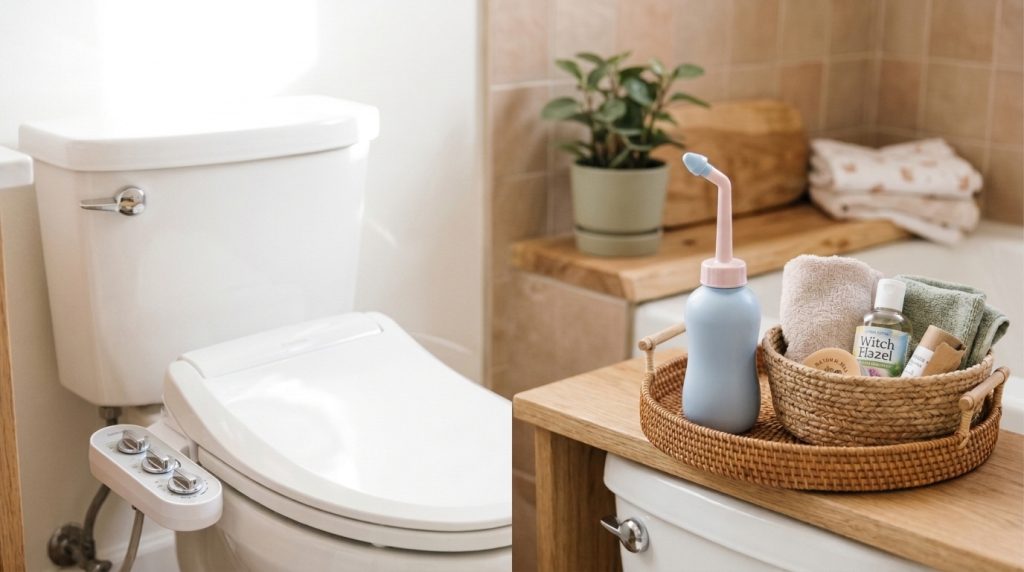
Why Rinsing Beats Wiping After Birth
Healing Tissue Needs Gentle Care
After a vaginal birth the perineum can be swollen, bruised or stitched. Dry paper drags across that skin, and rubbing is exactly what you want to avoid. Water lifts urine and residue away without friction.
What Maternity Teams Recommend
The advice from NHS maternity services and Boston Medical Center is consistent. Rinse with warm water after using the toilet, then gently pat dry rather than wipe, moving from front to back. Don’t wash inside the vagina, and change your pad at least every four hours. A West London NHS leaflet adds that pouring warm water over the area while you pass urine dilutes it, so it doesn’t sting the wound.
The First Bowel Movement
Many women dread it. The NHS leaflet says opening your bowels is safe and won’t damage your perineum or stitches, and suggests holding a clean pad against the area for the first few. Drink plenty of fluids and eat fibre, and ask your midwife about a stool softener if you are struggling. If hemorrhoids are part of the picture, there are ways to use bidets when having hemorrhoids.
What Is a Peri Bottle and How Does It Work?
A peri bottle is a small squeezable bottle with an angled spout, used to spray warm water over the perineum after you pee or have a bowel movement. Boston Medical Center describes it as spraying warm water on the area and then patting dry. A small jug works the same way, which is what suggested for pouring water over the area while you pass urine.
How to Use One
- Fill it with warm water, not hot.
- Sit on the toilet and angle the spout toward the perineum.
- Squeeze gently, front to back, while you pee or afterwards.
- Pat dry with a clean bidet towel or soft paper. Don’t rub.
The Pros
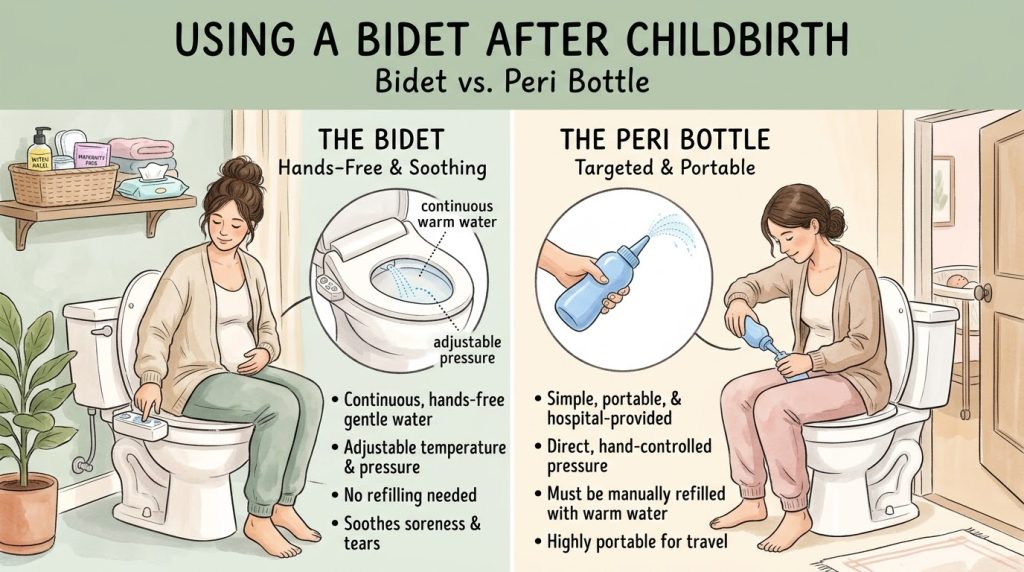
It is cheap, portable and gives you full control over the flow. Many hospitals give you one, and you can take it anywhere, including to another person’s home or a hospital room.
The Cons
You have to fill it, squeeze it and wash it, which is a nuisance when you are exhausted. The aim can be awkward with a sore body or a C-section scar, and the water runs out just when you need it.
Using a Bidet After Childbirth: How It Works
Using a bidet after childbirth follows the same principle as a peri bottle: warm water, external aim, pat dry. The difference is that the bidet supplies the water for you.
Why Many Mothers Like It
You stay seated, your hands stay free and the flow is steady, so there is no bending, squeezing or refilling. After a long night with a newborn, that matters. A West London NHS postnatal leaflet describes baths and bidets as soothing, and it still recommends patting dry rather than wiping.
Settings That Matter
Use lukewarm water and the lowest pressure. A hard jet on healing tissue is the main mistake. If your water runs cold, there are ways to warm up bidet water are worth taking a look.
Step by Step
- Wash your hands.
- Set lukewarm water and the lowest pressure.
- Rinse the outside from front to back for 15 to 30 seconds. Never aim inside the vagina.
- Pat dry with a clean towel or soft paper. Here is how to properly dry off after using a bidet.
- Put on a fresh pad.
Which Nozzle to Use
If you have two nozzles, use the front or feminine one for the vulva and the rear one for the bowels, rinsing front first and rear last. There is a difference between front wash and rear wash is very important, for targeting and for a better wash. This is very important if you want to use a bidet as a woman generally.
Bidet vs Peri Bottle: Side-by-Side Comparison
| Peri bottle | Bidet | |
|---|---|---|
| Control of flow | Full, by hand | Set once, steady |
| Effort | Fill, squeeze, refill | None once set |
| Water temperature | Fill with warm water | Depends on model, may need a warm-water option |
| Upfront cost | Low, often supplied | Higher, plus installation |
| Portability | Goes anywhere | Fixed to the toilet |
| Cleaning | Wash the bottle | Clean the nozzle |
| Best for | Hospital, travel, first days | Everyday use at home |
Which to Choose by Situation
- Stitches or a tear: either works. A peri bottle gives you direct control, and a bidet is fine at the lowest pressure once your midwife agrees.
- Hemorrhoids: a bidet avoids wiping and reaching, which helps.
- A C-section: perineal care matters less, but a bidet still saves bending and reaching.
- A shared bathroom or travel: a peri bottle is easier to keep clean and to carry.
The simplest plan is to use both: the peri bottle in hospital and the first days, and the bidet at home once you feel comfortable.
Special Situations
Stitches and Tears
According to NHS maternity guidance, stitches start to dissolve after about ten days and are usually gone by six weeks, and small pieces of thread may come away in the bath or on the toilet, which is normal. Your stitches should be checked within the first week. Use the lowest pressure and warm water, never aim at the wound directly, and stop if it stings. Ask your midwife before using a bidet if you had a third or fourth degree tear.
After a C-Section
A C-section doesn’t involve the perineum, so rinsing matters less, but you may still be bleeding and a bidet saves reaching and bending around your scar. Ask your team about anything specific to your recovery.
Hemorrhoids After Birth
Straining in labor and constipation afterwards can leave hemorrhoids behind. Water cleaning is gentler than wiping, and our guide to bidets and hemorrhoids covers pressure and temperature. If a bowel movement is a struggle, the NHS suggests fluids, fibre and, if needed, a stool softener from your midwife or GP, so you don’t have to strain.
Adding a Warm Bath or Sitz Bath
Rinsing is only one part of managing post-procedure discomfort. Warm baths and sitz baths soaking the area in 2 to 3 inches of warm water once or twice daily offer significant relief, though sessions should be kept to 10–20 minutes so excessive moisture does not delay tissue healing. For additional comfort, apply a cold pack to reduce swelling, or rest on your side to relieve direct pressure when sitting is painful. These measures work alongside a bidet or pri bottle to support recovery, rather than replacing gentle cleansing.
Hygiene and Safety Tips
Healing skin raises the stakes for hygiene, whichever method you use.
- Wash your hands before and after using the toilet or changing your pad, as NHS guidance advises.
- Keep the nozzle or bottle clean. Wash and rinse a peri bottle after each use and let it dry. For a bidet, it’s important to do a deep cleaning on the bidet nozzle and maintain general bidet hygiene periodically.
- Avoid shared bidets until you have healed, or clean the nozzle first.
- Skip perfumed products. It’s advised against using a perfumed soaps on the area.
- Never spray inside the vagina. Don’t ever mistake a bidet for a douche. The differences is quite noticeable. Even though a peri bottle can look very similar to a douche bottle; but their usage is different.
- Change pads at least every four hours and keep them in place so they don’t rub.
None of this is complicated, but it works best as a habit you do every time, including at 3 a.m.
When to Call Your Doctor or Midwife
Contact your midwife or GP if the perineal area becomes hot, swollen, weepy, smelly or very painful, if a repaired tear starts to open, or if you develop a temperature or flu-like symptoms. These can be signs of infection that needs antibiotics. Boston Medical Center lists a fever of 100.4°F (38°C) or higher, increasing pain and foul-smelling discharge as reasons to call your OB/GYN right away. Pain should ease each day, so pain that is getting worse is worth a call.
Frequently Asked Questions
Can I use a bidet after giving birth?
Generally yes. Using a bidet after giving birth is very soothing. Use lukewarm water, the lowest pressure and an external aim, and ask your midwife if you have stitches or a significant tear.
When can I start using a bidet after childbirth?
The guidance I found gives no set day, so ask your midwife. If you want the gentlest start, use a peri bottle for the first days and move to the bidet when you feel comfortable and your stitches have been checked.
Is a bidet better than a peri bottle?
Neither is better in medical terms. Both rinse with water and avoid wiping. A bidet is easier at home, and a peri bottle is portable and gives you manual control.
Can a bidet help with postpartum hemorrhoids?
It can help you clean without wiping, but it won’t treat them. Fluids, fibre and a stool softener, if your midwife suggests one, address the cause.
Is it okay to use a bidet with stitches?
Often, at low pressure and warm water, but ask your midwife first. Stitches usually dissolve within about six weeks. Stop if it stings or hurts, and call if you see signs of infection.
Final Thoughts
Using a bidet after childbirth: bidet vs. peri bottle isn’t really a contest. Both rinse without wiping, so choose by comfort and convenience: a peri bottle in the first days and on the go, a bidet at home once you feel ready. Keep the water lukewarm, the pressure low and the aim external, and call your midwife if pain increases or the area looks infected.