
Upgrading your bathroom to prioritize water-based personal hygiene is one of the most practical home improvements you can make. Beyond reducing paper consumption, gentle water cleansing protects sensitive skin, eases symptoms of hemorrhoids and fissures, and elevates everyday grooming.
When planning a high-end bathroom renovation or a custom new build, two premier fixtures stand at the top of the market: the standalone bidet and the integrated bidet toilet.
While both provide direct water cleansing, they represent radically different approaches to bathroom architecture, mechanical plumbing, day-to-day ergonomics, and electrical requirements.
This comprehensive guide breaks down everything you need to know about a standalone bidet vs. integrated bidet toilet including rough-in dimensions, total installed costs, plumbing and electrical codes, daily usability, and long-term resale value.
Standalone Bidet vs. Integrated Bidet Toilet: The Quick Answer
A standalone bidet is a separate porcelain washbasin plumbed alongside a standard toilet, using manual hot and cold tap valves without electricity. An integrated bidet toilet is a single, electronic smart fixture combining a high-efficiency toilet bowl, instant warm-water bidet wand, heated seat, and warm-air dryer inside a sleek tankless chassis.
What Is a Standalone Bidet?
A standalone bidet often referred to as a classic, traditional, or separate bidet is an independent ceramic plumbing fixture installed directly adjacent to the toilet. Popularized in 18th-century France and standard throughout Southern Europe, South America, and parts of the Middle East, this fixture is dedicated solely to washing and personal hygiene; it does not collect or flush solid waste.
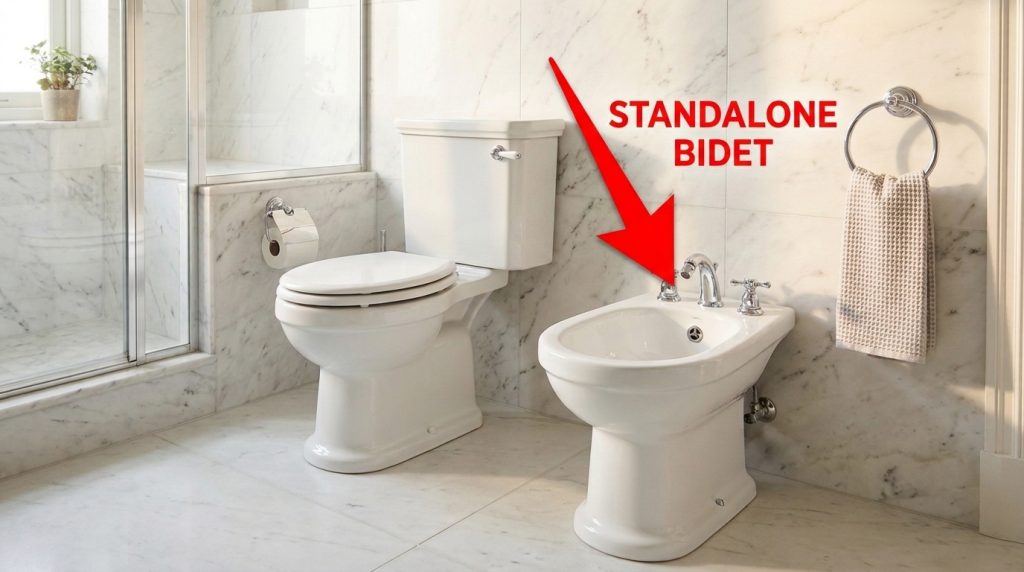
How a Separate Bidet Fixture Works
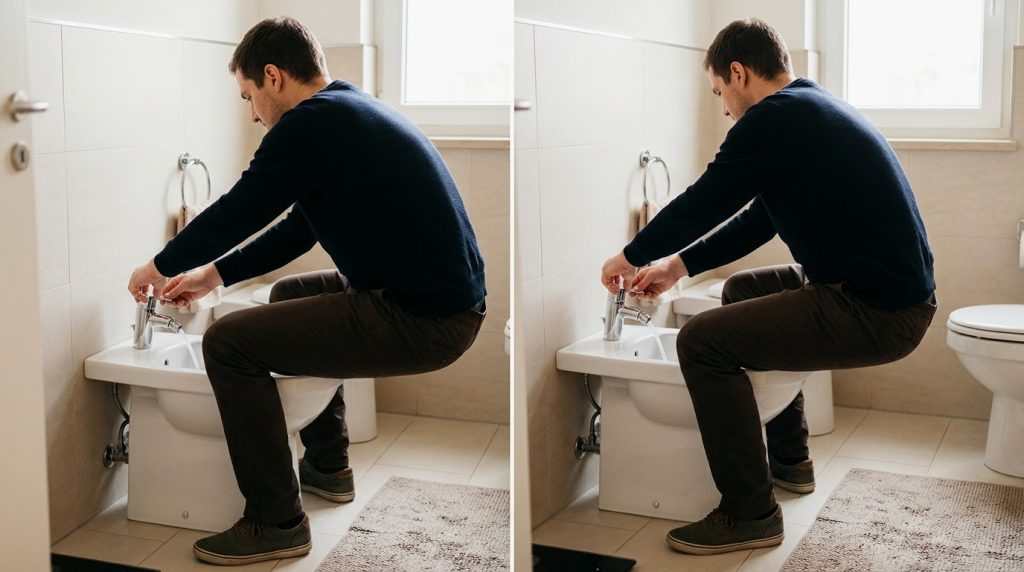
A standalone bidet functions similarly to an ultra-low sink basin. The user finishes using the conventional toilet, wipes or wipes lightly, stands up, straddles the bidet basin (either facing toward the faucet handles or facing away), and manually adjusts the water valves to wash the perianal and genital regions.
The basin features an open bowl equipped with an internal pop-up drain stopper and an overflow channel. Rinse water drains into your home’s greywater or secondary wastewater plumbing through a dedicated 1.25-inch or 1.5-inch P-trap, completely separate from the toilet’s 3-inch or 4-inch soil stack. Because the basin is stationary porcelain, it provides a stable, wide cleaning area.
Over-the-Rim vs. Under-the-Rim Designs
Standalone bidets generally utilize one of two architectural plumbing configurations:
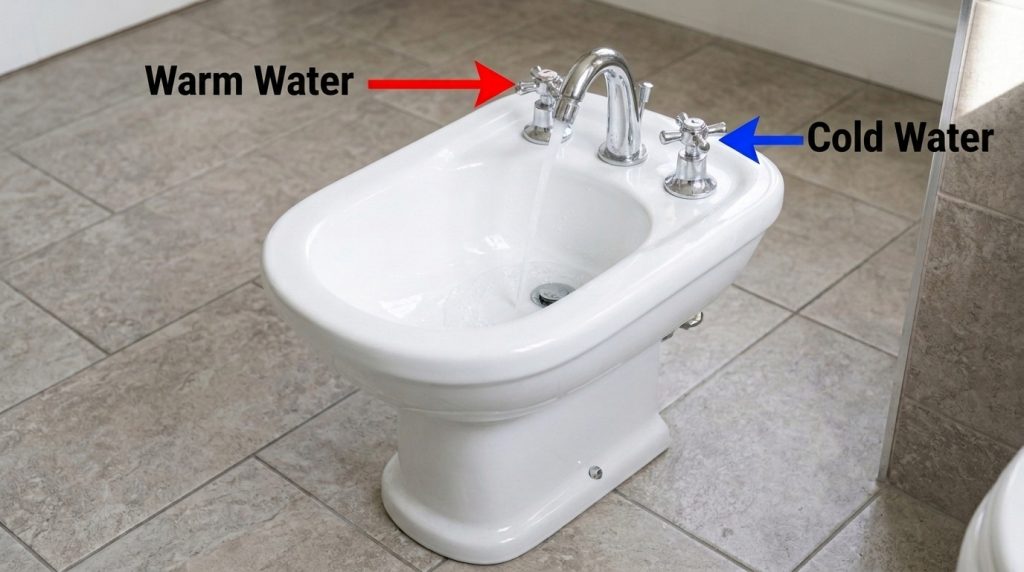
- Over-the-Rim Spout (Deck-Mounted Faucet): The most common contemporary design. A specialized bidet faucet mounts to the ceramic deck of the bidet, featuring hot and cold mixer levers and an articulated, swiveling aerator spout. The spout angles downward or upward into the basin, letting you direct the water stream manually.
- Under-the-Rim / Vertical Jet (Ascending Spray): A classic European design where water flows through internal channels molded directly beneath the porcelain rim or emerges from a vertical spray nozzle positioned in the center of the basin floor. The water pools in the basin or shoots a gentle fountain upward, allowing you to submerge and rinse the targeted areas directly.
Hot and Cold Water Without Electricity
The defining mechanical advantage of a standalone bidet is that it operates completely without electrical wiring or circuit boards. Hot and cold water lines connect directly to household plumbing pipes — identical to a standard bathroom vanity faucet.
You control water temperature and pressure through mechanical brass cartridges. This provides unlimited, continuous warm water drawn from your home’s central water heater, with zero electrical consumption and complete immunity to power outages.
What Is an Integrated Bidet Toilet?
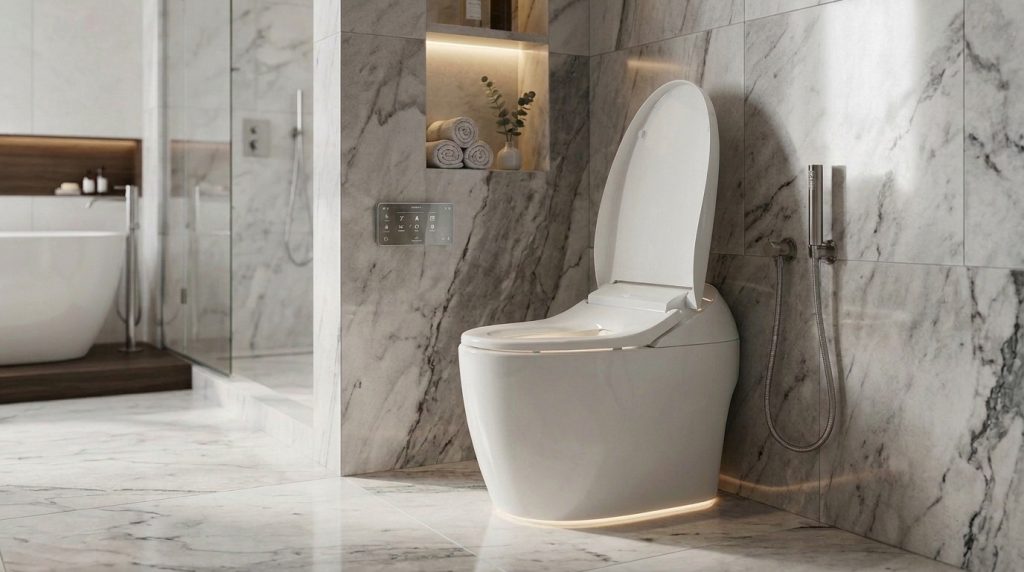
An integrated bidet toilet also called an all-in-one bidet toilet or smart toilet — is a single electronic fixture engineered from the ground up to combine a high-efficiency toilet and a motorized bidet wash system inside a unified porcelain housing.
Unlike an aftermarket bidet seat bolted onto a standard toilet, an integrated unit conceals all water pumps, instant ceramic heaters, motorized drive gears, solenoid valves, and wiring within a seamless, skirted vitreous china shell.
How the Toilet and Bidet Work as One Unit
In an integrated smart toilet, the waste-evacuation mechanism and personal hygiene functions share the same bowl. When you sit down, an optical or capacitive seat sensor activates the unit. An internal pre-mist function sprays a thin film of water or electrolyzed water onto the ceramic bowl surface to prevent waste adherence.
When you finish using the toilet, you do not need to stand up, turn around, or transfer fixtures. Instead, you press a button on a wall-mounted wireless remote control or side panel. An electric solenoid opens, water routes through an on-demand ceramic core heater, and a motorized stainless steel or antimicrobial plastic wand extends into the bowl.
The wand targets the wash area with pinpoint precision, cycles through user-selected oscillating or pulsating modes, and retracts behind a self-sanitizing flush gate. Once you stand up, an automatic sensor activates an internal high-velocity cyclone flush, emptying the bowl without manual handle contact.
Luxury Features: Heated Seat, Dryer, Deodorizer, Remote
Integrated bidet toilets represent the cutting edge of residential bathroom technology. Premium models include:
- Instantaneous Tankless Water Heating: Continuous, endless warm water heated on-demand within 0.2 seconds.
- Multi-Stage Heated Seating: Thermostatically controlled seat rings with programmable energy-saving schedules.
- Warm-Air Drying Fans: Multi-speed, temperature-adjustable air blowers that eliminate the need for toilet paper.
- Active Carbon Deodorization: An internal fan draws air through a catalytic carbon filter inside the bowl to neutralize volatile organic compounds (VOCs) and odors before they escape.
- Hands-Free Automation: Radar proximity sensors detect your approach, automatically opening the motorized lid, illuminating the bowl with a nightlight, and closing the lid and flushing when you step away.
- Electrolyzed Water Sanitization: Systems like Toto’s eWater+ electrochemically treat incoming tap water to create a mild hypochlorous acid mist that sanitizes the wand and bowl after each use.
Why It Needs an Electrical Outlet
Integrated smart toilets require a continuous 120V electrical supply to power their electronic control boards, electric solenoids, air compressors, and instant heaters. Instant ceramic water heaters draw between 1,000 and 1,400 watts during an active 60-second wash cycle.
Consequently, an integrated bidet toilet must plug into a dedicated Ground-Fault Circuit Interrupter (GFCI) outlet installed on the wall within 3 feet of the porcelain base, in strict compliance with the National Electrical Code (NFPA 70).
Standalone Bidet vs. Integrated Bidet Toilet: Side-by-Side Comparison
| Feature / Metric | Standalone Bidet | Integrated Bidet Toilet |
|---|---|---|
| Typical Total Cost (Installed) | $1,200 – $3,500+ | $1,500 – $6,000+ |
| Space Footprint Required | Full secondary fixture (~30″ W × 48″ D) | Standard single toilet footprint (~18″ W × 30″ D) |
| Plumbing Supply Lines | Dedicated Hot & Cold 1/2″ lines | Single Cold 1/2″ or 3/8″ line |
| Drainage System | 1.25″ or 1.5″ P-trap to greywater drain | Standard 3″ or 4″ soil stack flange |
| Electrical Power Needed | None (100% mechanical) | 120V / 15A dedicated GFCI wall outlet |
| Water Temperature Mechanism | Home central water heater via mixer tap | Internal on-demand electric heating coil |
| Drying System | Manual pat-dry with bidet towel | Built-in warm-air drying fan |
| User Physical Movement | Stand and transfer from toilet to bidet | Sit in place; full cycle is stationary |
| Bowl / Nozzle Aiming | Manual body positioning over stream | Motorized wand positionable via remote |
| Secondary Utility | Foot soaking, cloth rinsing, pet washing | Personal toilet hygiene exclusively |
| Installation Complexity | Major rough-in plumbing (floor & walls) | Standard toilet rough-in + electrical hookup |
| Resale Market Appeal | Niche / Polarizing (Requires spacious bath) | High universal luxury appeal |
Space and Bathroom Layout
Bathroom square footage and structural clearances are frequently the deciding factors when evaluating a standalone bidet vs. integrated bidet toilet.
How Much Room a Standalone Bidet Needs
Installing a separate bidet basin requires dedicating an entirely new fixture station to your bathroom floor plan. Under standard building codes, including the International Residential Code (IRC) and Uniform Plumbing Code (UPC), minimum spatial clearances are legally mandated:
- Centerline Clearance: There must be a minimum of 15 inches (ideally 18 inches) from the centerline of the bidet to any side wall, partition, or adjacent fixture.
- Distance Between Fixtures: Placing a standalone bidet next to a toilet requires at least 30 inches of dedicated center-to-center clearance between the two bowls.
- Front Clearance: A minimum of 21 inches (ideally 24 to 30 inches) of clear floor space must exist in front of the bidet rim to allow users to comfortably mount, straddle, and dismount the basin.
In practical terms, adding a standalone bidet requires at least 6 to 9 square feet of unobstructed floor area and a continuous unobstructed wall run of roughly 6 feet to accommodate both fixtures comfortably.
Why Integrated Toilets Suit Small Bathrooms
An integrated bidet toilet consolidates all personal cleansing functions directly inside the existing toilet footprint. Because it replaces your current toilet on the exact same 12-inch floor flange, it requires zero additional square footage.
Furthermore, most integrated smart toilets are tankless. By replacing a standard bulky ceramic gravity tank with an internal direct-pressure booster pump, integrated fixtures reduce the forward projection into the room by 2 to 4 inches compared to conventional two-piece toilets. This makes integrated bidet toilets ideal for compact primary bathrooms, powder rooms, and urban condo renovations where adding a second fixture is physically impossible.
Rough-In, Clearances, and Local Code Basics
When remodeling, rough-in alignment dictates your labor scope:
- The Standalone Rough-In: Requires opening the subfloor to route a 1.5-inch drain pipe with a proper vent stack, plus opening the drywall to stub out hot and cold supply copper or PEX lines at a precise height (typically 6 to 8 inches above finished floor).
- The Integrated Rough-In: Uses your existing standard 12-inch rough-in toilet waste flange. However, you must confirm that your home’s dynamic municipal water flow meets the manufacturer’s threshold—typically a minimum flow rate of 5.3 to 9.0 gallons per minute at 35 PSI—to support high-efficiency cyclone flushing without a gravity storage tank.
Cost: Fixture, Installation, and Long-Term Value
Evaluating the true financial commitment of a standalone bidet vs. integrated bidet toilet requires tallying fixture retail pricing, rough-in mechanical labor, electrical trades, and ongoing operational costs.
What a Standalone Bidet Costs Once Plumbing Is Added
A standalone bidet basin appears misleadingly inexpensive when looking at fixture price tags alone. A quality vitreous china bidet basin from Kohler, Duravit, or Toto typically retails for $300 to $800. A matching dedicated deck-mount bidet faucet adds $150 to $400.
However, the real cost lies in the rough-in plumbing:
- Drain and Venting: Tying a new 1.5-inch P-trap and vent line into an existing drain stack through subfloors or concrete slabs costs between $600 and $1,500.
- Hot and Cold Water Supply Lines: Tapping into existing domestic hot and cold lines and running new pipe stubs through the wall costs $400 to $1,000.
- Finished Flooring & Drywall Patching: Tiling and repairing drywall around newly opened plumbing chases typically adds $300 to $800.
Total Realistic Installed Cost: $1,450 to $3,700+.
What an Integrated Bidet Toilet Costs, Tier by Tier
An integrated bidet toilet concentrates its financial cost inside the appliance itself:
- Entry-Tier Smart Toilets ($900 – $1,400): Brands like Woodbridge, Horow, and DeerValley offer baseline models featuring heated seats, ambient or tanked warm water, manual remote controls, and automatic single-stage cyclone flushes.
- Mid-Tier Performance Units ($1,500 – $2,800): Models from Bio Bidet, Brondell, and Moen add instant tankless ceramic water heating, stainless steel multi-position wands, oscillating wash patterns, UV sanitization, and automatic lid sensors.
- Flagship Architectural Smart Toilets ($3,500 – $7,500+): Industry benchmarks such as the Toto Neorest series or Kohler Veil feature ultra-quiet cyclone flushing, integrated rimless bowl glazes (such as Toto’s CeFiONtect), electrolyzed water mists, and automated proximity sensors.
Labor for an integrated unit is straightforward:
- Plumber Installation: A standard toilet pull and replacement onto an existing 12-inch wax ring or rubber gasket costs $250 to $500.
- Licensed Electrician: Installing a new 120V / 15A GFCI outlet adjacent to the toilet costs $200 to $400.
Total Realistic Installed Cost: $1,350 to $8,400+.
Running Costs and Repairs
- Standalone Bidet: Running costs are virtually zero, beyond the nominal energy required by your central water heater to warm 1 to 2 pints of water. Mechanical brass cartridges last 10 to 15 years, and replacement washers or ceramic discs cost under $30 at any plumbing supply house.
- Integrated Bidet Toilet: The standby power consumption of an integrated smart toilet in eco-mode draws 2 to 5 watts, ramping up to 1,200 watts during active wash and dry cycles. This adds approximately $2.00 to $4.50 per month to household utility bills.
Repairs for integrated units are more specialized. Because electronic control boards, heating coils, and micro-pumps are proprietary, repairs outside of the manufacturer’s 1- to 3-year warranty window often require authorized service technicians and brand-specific components.
Installation and Plumbing Requirements
Plumbing requirements differ significantly between standard pressurized supply lines and gravity-fed wastewater drainage.
Standalone: Hot and Cold Lines, Drain, Backflow Protection
A standalone bidet must be treated as a full plumbing installation with three specific connections:
- Hot & Cold Pressurized Lines: Requires running two independent 1/2-inch copper or PEX water supply pipes through the wall, terminating in dual angle stops at the bidet base.
- Dedicated Waste Drain: Requires a dedicated 1.25-inch or 1.5-inch drain pipe connected to a P-trap beneath the floor. Under plumbing code, you cannot dump standalone bidet waste directly into a toilet flange without proper trapping and venting to prevent toxic sewer gases from entering the living space.
- Backflow Prevention (Vacuum Breakers): For ascending spray or under-the-rim bidets where water nozzles sit below the ceramic flood level rim, local plumbing codes strictly require an atmospheric vacuum breaker (AVB) or backflow preventer compliant with ASSE 1001. This prevents contaminated basin water from being siphoned back into your home’s potable drinking supply in the event of municipal pressure drops.
Integrated: Toilet Swap, GFCI Outlet, Water Line
Installing an integrated bidet toilet mirrors a standard toilet replacement, with two specific modern prerequisites:
- Dynamic Water Pressure: Because integrated units lack a gravity water tank, their flush engines rely on direct water line velocity. Ensure your supply line is at least 1/2-inch (ideally 3/4-inch feeding the bathroom) and delivers at least 30 to 35 PSI of dynamic operating pressure.
- Dedicated Electrical Outlet: A 120V GFCI outlet must be installed low on the wall behind or beside the toilet skirt. The outlet should be located within 3 feet of the porcelain base, positioned at least 6 to 12 inches above finished floor level to protect against floor moisture.
- Flange Alignment: Integrated skirts leave zero tolerance for crooked floor flanges. The closet bolts and wax ring (or synthetic seal) must sit perfectly level to prevent rocking or sewer gas leaks.
Do You Need a Plumber or an Electrician?
- For a Standalone Bidet: You unequivocally need a licensed master plumber. Cutting into existing drain stacks, setting up proper vent piping, and roughing in hot and cold supply lines within walls is not a DIY task.
- For an Integrated Bidet Toilet: You will need a licensed electrician for roughly one hour to run the dedicated GFCI outlet if one does not already exist. However, the physical unboxing and mounting of the toilet can be handled by an experienced homeowner or a standard plumbing contractor in under two hours.
Comfort, Hygiene, and Daily Use
Day-to-day usability highlights the ergonomic differences between the two fixtures:
Water Temperature and Control
- Standalone Bidet: Delivers continuous warm water supplied by your home’s central water heater. However, if your water heater is located across the house, you may have to run the bidet faucet for 15 to 30 seconds before water reaches a comfortable temperature. Pressure control is completely manual via brass levers, allowing you to dial in everything from a gentle trickle to a firm flow.
- Integrated Bidet Toilet: Modern tankless ceramic heating elements deliver instantly warm water from the first second of spraying. Digital pressure controls allow you to select your preferred setting, while automated oscillating modes widen coverage without requiring you to move.
Hands-Free and Accessibility Features
- Standalone Bidet: Requires significant physical mobility. The user must stand up from the toilet, maneuver over to the adjacent basin, adjust their clothing to clear the bidet rim, straddle the basin, and manually wash with their hands or a washcloth. This makes standalone bidets difficult or impractical for seniors, arthritis patients, or individuals recovering from joint surgery.
- Integrated Bidet Toilet: The user remains comfortably seated on the same bowl. Everything—from wand positioning and wash duration to water temperature and warm-air drying—is controlled via large-button wall remotes or automatic sensors. For aging-in-place homeowners, individuals with limited mobility, or postpartum recovery, integrated smart toilets provide independence and dignity without requiring twisting, reaching, or transferring.
Cleaning and Maintenance
- Standalone Bidet: Adding a second ceramic basin means having an additional fixture to clean. The exposed faucet aerator, handles, drain stopper, and exterior porcelain bowl collect dust and bathroom moisture, requiring regular scrubbing.
- Integrated Bidet Toilet: Simplifies bathroom cleaning. The skirted porcelain base conceals the trapway and plumbing lines, creating flat ceramic sides that wipe down in seconds. Furthermore, internal self-cleaning cycles sanitize the spray wand before and after every use, and rimless cyclone bowl designs prevent waste buildup.
Pros and Cons of Each
Standalone Bidet Pros and Cons
Pros:
- Timeless European Aesthetic: Adds a classic, luxurious visual statement to spacious primary bathrooms.
- 100% Non-Electric Operation: Requires zero electrical wiring, adds nothing to your electric bill, and functions during power outages.
- Endless Hot Water: Draws directly from your home water heater without electrical heating elements.
- Multipurpose Utility: Functions as a practical low-rim sink for soaking feet, washing toddlers’ feet, or hand-rinsing garments.
- Exceptional Durability: No circuit boards, sensors, or motorized gears to malfunction; brass valves last for decades.
Cons:
- Large Footprint: Requires 6 to 9 square feet of open bathroom space, making it impractical for standard bathrooms.
- High Rough-In Plumbing Cost: Tying into drain, vent, and hot-water lines can cost thousands in labor.
- Ergonomic Transfer Required: Users must stand up, move, and straddle a secondary fixture mid-routine.
- No Built-In Drying: Leaves users wet, requiring dedicated cotton towels or toilet paper to pat dry.
Integrated Bidet Toilet Pros and Cons
Pros:
- Space-Saving Design: Fits directly onto a standard toilet rough-in, providing bidet functionality without taking up extra space.
- Total Hands-Free Cleansing: Automated wands, oscillating sprays, warm-air dryers, and auto-flushing let you complete your routine without moving.
- Instant On-Demand Warm Water: Instantaneous ceramic heating elements provide steady warm water without running the tap.
- Superior Ergonomics & Accessibility: Ideal for seniors, postpartum mothers, and individuals with limited mobility.
- Easy Exterior Cleaning: Skirted trapways and automated bowl mists keep the toilet cleaner with less manual scrubbing.
Cons:
- Higher Upfront Fixture Cost: Premium units cost between $1,200 and $5,000+.
- Electrical Requirement: Requires a dedicated 120V GFCI outlet near the toilet.
- Proprietary Repairs: Electronic control boards and internal pumps require specialized parts if they malfunction outside warranty.
Which Should You Choose?
Here is how to make the right choice:
Choose a Standalone Bidet If:
- You are designing an expansive primary suite with ample square footage to accommodate separate fixtures side by side.
- You love traditional, European-inspired interior architecture and want an elegant porcelain statement piece.
- You want a non-electric, purely mechanical fixture that provides unlimited hot water without drawing power.
- You want a multipurpose washing basin that can double as a foot bath or delicate garment rinse sink.
- You have full physical mobility and do not mind transferring between fixtures mid-routine.
Choose an Integrated Bidet Toilet If:
- You are working within a standard bathroom footprint where floor space is at a premium.
- You want hands-free automation, including warm-air drying, heated seating, auto-flushing, and deodorization.
- You are remodeling for aging in place, accessibility, or want a comfortable fixture for family members with limited mobility.
- You want an easy installation that replaces your current toilet on the existing 12-inch floor drain flange.
- You want a sleek, modern aesthetic with concealed plumbing and skirted porcelain surfaces that are easy to wipe clean.
A Cheaper Third Option: An Electric Bidet Seat
If an integrated smart toilet exceeds your renovation budget ($1,500+) and your bathroom cannot accommodate the floor space or rough-in plumbing of a standalone bidet, an aftermarket electric bidet seat ($200 to $650) is an excellent middle ground.
Models from brands like Toto (the Washlet series), Brondell, and Bio Bidet bolt directly onto your existing porcelain toilet in under 30 minutes. They connect to your current cold-water line and plug into a GFCI outlet, delivering the same instant warm water, heated seating, and warm-air drying as an integrated unit for a fraction of the cost.
Frequently Asked Questions
Is a standalone bidet better than a bidet toilet?
Neither is objectively better; they serve different bathroom layouts and user preferences. A standalone bidet is superior for homeowners with large bathrooms who want a classic, unpowered fixture for multipurpose washing. An integrated bidet toilet is better for standard bathrooms, providing hands-free automation, instant water heating, and warm-air drying within a single fixture footprint.
Can you have a bidet toilet and a standalone bidet in the same bathroom?
While technically possible, installing both is redundant. An integrated bidet toilet already handles posterior and feminine cleansing with motorized wands, warm air, and auto-flushing. Installing a standalone bidet alongside it wastes floor space and plumbing budget unless you specifically want a separate basin for foot washing or hand-washing items.
Do integrated bidet toilets work without electricity?
Yes, but with limited features. If the power goes out, the heated seat, warm-water wand, and air dryer will not operate. However, manufacturers include a manual mechanical button, an under-skirt manual pull cord, or a 9V battery backup port so you can still flush solid waste during an electrical outage.
Which adds more value to a home?
In contemporary real estate markets, an integrated bidet toilet generally adds broader buyer appeal. Modern home buyers value high-tech, space-efficient smart fixtures that streamline daily routines. Standalone bidets can be polarizing: while luxury buyers seeking traditional European design appreciate them, others view a second basin as an outdated fixture that consumes valuable master bathroom square footage.
Yes. Water from a standalone bidet flows directly from your municipal drinking supply line and drains away through a dedicated trap. The basin does not collect or store waste. As long as the ceramic surfaces are wiped down during routine bathroom cleaning, a standalone bidet is just as sanitary to share as a standard bathroom hand-washing sink.
Final Thoughts
The choice between a standalone bidet vs. integrated bidet toilet ultimately hinges on your bathroom’s square footage, your renovation budget, and how much you value automated comfort. A standalone bidet offers classic, unpowered mechanical washing for expansive primary suites, while an integrated bidet toilet delivers streamlined, hands-free luxury that fits perfectly into modern bathroom designs.