Installing or fixing a bidet does not require a plumbing license. Once you look past the plastic shell, these units run on straightforward mechanical and electrical setups. Knowing the exact parts of a bidet and what they do helps you install a seat properly, fix annoying drips, and keep everything working smoothly.
Below is an honest, breakdown of the entire anatomy of a bidet, explaining how do bidet parts work, where to find bidet replacement parts, and how to quickly troubleshoot common bidet leak points.
What Are the Main Components of a Bidet?
If you strip down any model on the market, what are the main components of a bidet?
Every unit relies on three basic groups:
- Water hookups: The fittings that pull tap water from your bathroom shutoff valve into the unit.
- Mounting gear: The plastic plate and bolts holding the seat rigid to the porcelain bowl.
- The wash mechanism: The motorized wand, nozzles, safety switches, and dials that spray clean water where you need it.
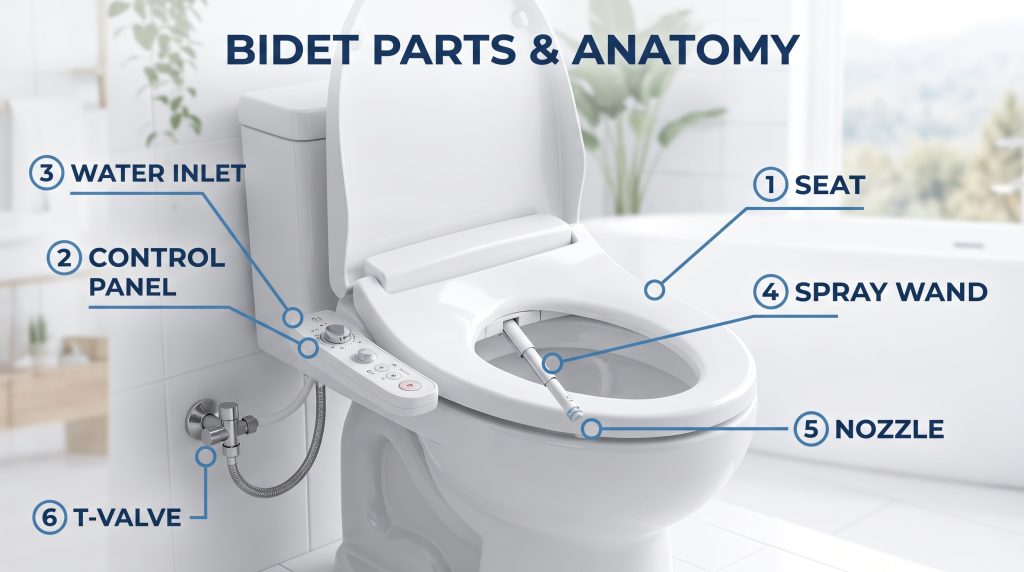
Parts of a Bidet and What They Do: Quick Reference Table
Use this scannable reference table to see what each piece does and whether it applies to simple attachments or powered seats:
| Part Name | Category | What It Does | Found On |
| Bidet T-Valve Adapter | Plumbing | Splits clean water between the toilet tank and bidet | All styles |
| Bidet Supply Hose | Plumbing | Carries pressurized water into the bidet body | All styles |
| Inlet Mesh Filter | Plumbing | Catches dirt, rust, and pipe scale before it enters the unit | All styles |
| Bidet Mounting Bracket | Hardware | Base plate that bolts to the bowl to hold the seat | Seats & attachments |
| Mounting Bolts & Nuts | Hardware | Locks the bracket securely through the toilet holes | Seats & attachments |
| Quick-Release Button | Hardware | Lets you slide the seat off with one click for easy cleaning | Bidet seats |
| Retractable Spray Wand | Wash Core | Telescoping arm that slides out over the bowl | All styles |
| Bidet Nozzle Parts & Tips | Wash Core | Removable tip with holes for rear and front washes | All styles |
| Splash Guard Gate | Hygiene | Little door shielding the nozzle from toilet splashes | All styles |
| Bidet Seat Sensor | Safety | Detects when your skin touches the seat so it won’t spray an empty room | Electric bidets |
| Bidet Control Panel | Interface | Dials or buttons used to adjust spray and heat | All styles |
| Water Heating Core | Comfort | Warms up the water (small tank or instant heater) | Electric bidets |
| Warm-Air Dryer Fan | Comfort | Blows warm air so you can dry off without paper | Electric bidets |
| Carbon Deodorizer | Air Filter | Tiny fan pulling bowl air through a charcoal filter | Electric bidets |
Plumbing & Water Connection Parts (And What They Do)
The plumbing assembly carries tap water directly from your wall pipe into the bidet. It sits under constant line pressure, so installing these pieces correctly is your top defense against leaks.
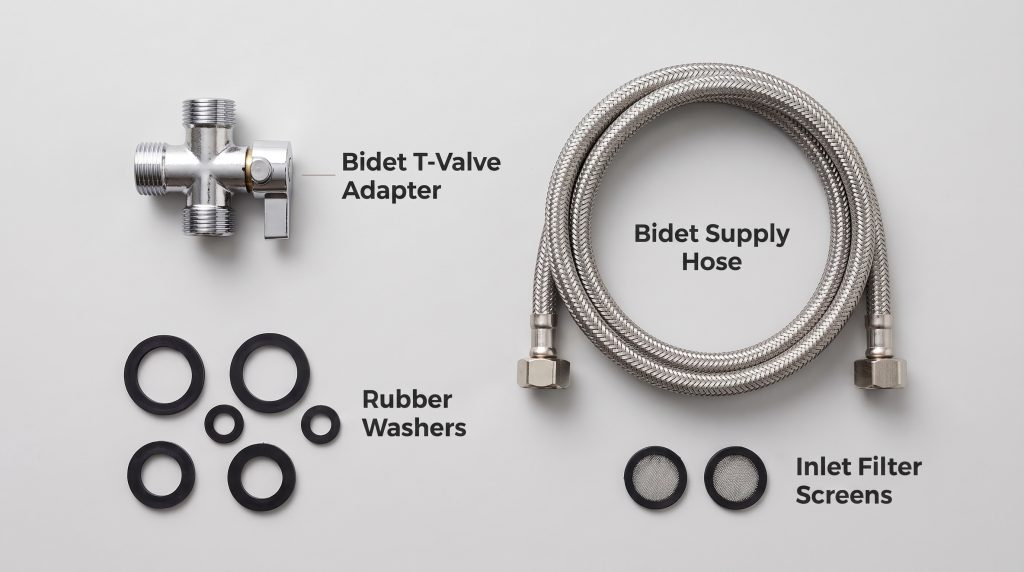
1. The Bidet T-Valve Adapter
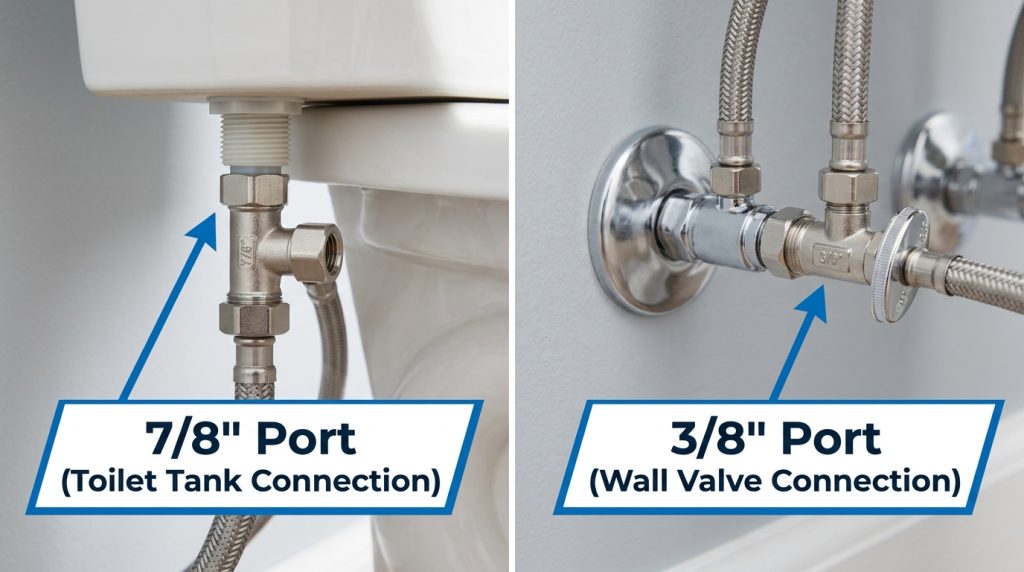
The bidet t valve adapter screws right onto the threaded shank at the bottom of your toilet tank.
- What it does: It splits your water line into two paths. One path sends water up to refill the toilet tank after a flush; the other routes fresh water directly into your bidet.
- Safety codes: Reliable hardware follows IAPMO plumbing and backflow standards. This ensures dirty water cannot back-siphon into your home’s clean drinking supply.
- Sizing: In the US and Canada, standard fittings use a 7/8-inch thread for the toilet tank and wall line, plus a 3/8-inch or 1/2-inch side port for the bidet hose.
2. The Bidet Supply Hose
The bidet supply hose connects the side port of the T-valve to the water intake on your bidet.
- What it does: It moves pressurized water up into the seat.
- Build quality: Quality hoses feature a tough rubber or polymer inner core wrapped in braided stainless steel. Built to meet ASME flexible water connector guidelines, this metal braid keeps the line from swelling, kinking, or bursting during sudden pressure changes.
3. Rubber Washers & Inlet Filter Screens
- Rubber washers: Soft rubber rings sitting inside every connection nut. Hand-tightening squishes the rubber against the metal to form a watertight seal without needing plumbing tape.
- Mesh screen: A tiny metal mesh tucked inside the bidet’s water inlet. It catches sand, rust, and calcium flakes before they can jam up sensitive internal valves.
Structural & Mounting Parts
A bidet must stay locked in place so it does not shift or crack when you sit on it.
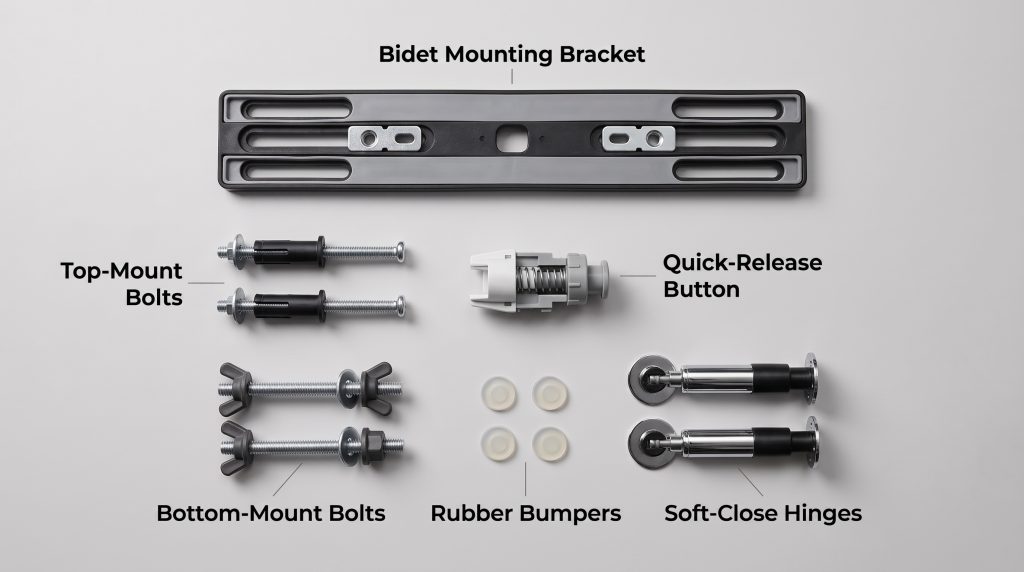
1. The Bidet Mounting Bracket
The bidet mounting bracket is the foundation plate for your seat.
- What it does: You bolt this plate directly onto the flat porcelain rim where your old toilet seat used to sit. The new bidet seat then slides onto the bracket until it clicks locked.
- Sizing rules: Bowls follow standard ASME ceramic fixture measurements. The mounting bracket features adjustable sliding slots matching standard bolt hole spacing (usually 5.5 inches), letting you slide the seat forward or backward to line up with round (16.5-inch) or elongated (18.5-inch) bowls.
2. Mounting Bolts: Top-Mount vs. Bottom-Mount
- Top-mount rubber expansion nuts: Used on modern skirted toilets with smooth outer sides where you cannot reach underneath. You drop rubber sleeves into the holes from above; tightening the bolt pulls an inner nut up, swelling the rubber tightly inside the hole.
- Bottom-mount bolts: Used on open toilets. Long metal or plastic bolts drop through the deck and tighten from below with wing nuts and flat rubber washers.
3. Quick-Release Button
Located on the side of the seat, this button releases the internal catch from the bidet mounting bracket. Press it, and the entire seat slides forward off the bowl in two seconds, giving you clear access to scrub away grime under the hinges.
4. Rubber Bumpers & Soft-Close Hinges
- Seat bumpers: Molded rubber feet on the underside of the seat ring. They absorb your body weight and keep the plastic frame resting flat on the bowl so it does not flex or crack.
- Damper hinges: Sealed internal oil dampers that close the lid slowly and quietly, preventing loud slams.
Spray & Internal Cleaning Parts
The spray core does the actual work of washing your skin cleanly and gently.
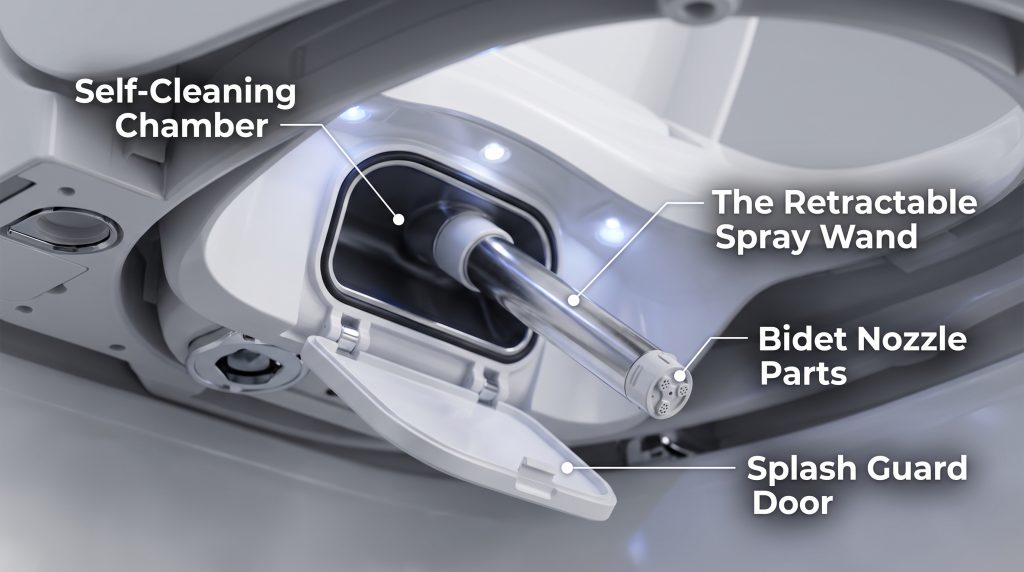
1. The Retractable Spray Wand
The spray wand is a long, hollow tube tucked horizontally inside the back of the bidet.
- What it does: When you start a wash, water pressure or an internal electric motor pushes the wand forward over the bowl at a 40- to 45-degree angle.
- Motor drive: Electric models use a miniature gear track that lets you nudge the nozzle forward or backward from your remote to hit the exact spot you want.
2. Bidet Nozzle Parts and Tip Styles
The front tip of the wand holds the bidet nozzle parts:
- Dual holes: Most tips feature two separate hole groupings—a focused jet for rear washing and a wider, gentler pattern set further forward for feminine washing.
- Air aeration: Electric models pull air into the water stream right before it exits the tip. These air bubbles make the spray feel soft and full while using less water. A clinical study published on PubMed showed that gentle, warm aerated washing lowers anal resting pressure, making it much easier on inflamed tissue than dry paper.
- Medical relief: This touch-free wash is why groups like the American Society of Colon and Rectal Surgeons (ASCRS) advise using water cleansing instead of dry wiping to soothe hemorrhoids and anal fissures.
- Materials: Inexpensive attachments use ABS plastic, while higher-end seats use solid antimicrobial stainless steel that resists bacteria and mineral buildup.
3. Splash Guard Door & Self-Cleaning Chamber
- Splash door: A spring-loaded door covers the nozzle opening. When you sit down, the door stays shut to block toilet splashes. When you turn on the wash, the extending wand pushes the door open, and a spring snaps it shut when the wand slides back.
- Self-cleaning flush: The bidet automatically runs fresh water over the outside of the nozzle for several seconds right before it extends and immediately after it retracts, rinsing off stray droplets into the bowl.
Controls and User Interfaces
Your control setup determines how easily you operate the unit.
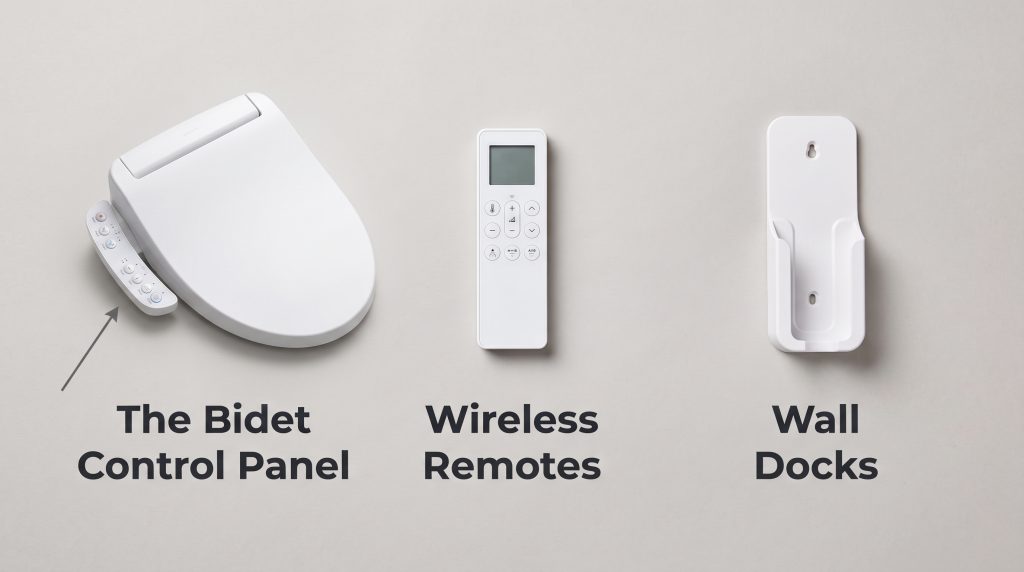
1. The Bidet Control Panel
The bidet control panel is your physical interface:
- Mechanical side dials: Non-electric attachments use a side arm with simple turn dials. Turning the dial opens an internal valve by hand; turning it further boosts water flow.
- Attached electric side arms: Budget electric seats feature an arm console on the right side with sealed rubber buttons over a waterproof circuit board.
2. Wireless Remotes and Wall Docks
Mid-tier and luxury seats replace the side console with a wireless wall-mount remote.
- How it talks: The remote uses low-power radio or infrared signals approved under FCC Part 15 wireless standards to send commands to the seat.
- Features: Remotes include clear buttons or screens to adjust water heat, nozzle position, spray pressure, and seat temperature without twisting around to look at the side of your toilet.
Advanced Electric Bidet Parts
Electric bidets add automated comfort, temperature control, and safety switches.
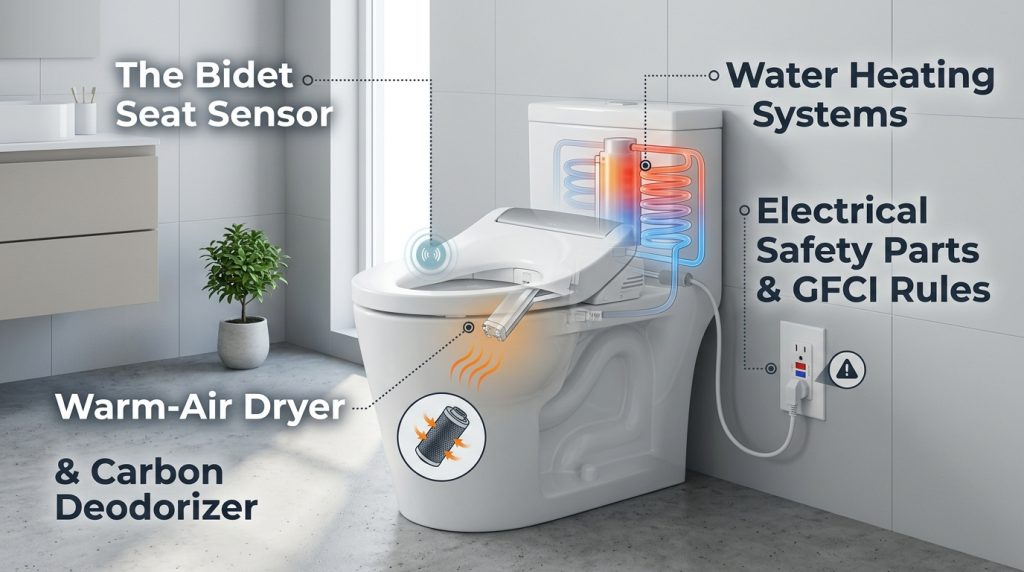
1. The Bidet Seat Sensor
The bidet seat sensor is a safety switch built directly into the plastic seat ring.
- How it works: It uses skin capacitance (like a smartphone screen) or an internal pressure switch that detects your weight.
- Why it matters: It stops accidental bathroom floods. If a curious child or pet presses buttons on the bidet control panel when no one is sitting down, the sensor knows the seat is empty and cuts power to the water valves.
2. Water Heating Systems: Tank vs. Tankless Ceramic
Electric bidets heat water in one of two ways:
- Tank heaters: A small 25-ounce tank with an internal heating element. It keeps water warm 24/7 using 50 to 70 watts. You get 30 to 45 seconds of warm water before it runs cold, taking 3 to 5 minutes to heat back up.
- Instant ceramic cylinders: A ceramic tube wrapped in high-output heating coils (1,200 to 1,400 watts). As cold water passes through the cylinder, it flash-heats on demand, giving you continuous warm water that never runs out.
- Power bills: Even though instant heaters draw high wattage while running, they only run for 30 to 60 seconds at a time. Residential rate data from the U.S. Energy Information Administration (EIA) shows that running a heated seat adds just $2 to $4 per month to an electric bill.
3. Electrical Safety Parts & GFCI Rules
Because these seats mix water and electricity, they are tested against strict UL 1431 personal hygiene electrical standards. In addition, the National Electrical Code (NEC) Section 210.8 requires that any bathroom outlet near a water line must have Ground-Fault Circuit-Interrupter (GFCI) protection to eliminate shock risks.
4. Warm-Air Dryer & Carbon Deodorizer
- Dryer blower: A tiny fan and 250-watt heating coil blow warm air across your skin for hands-free drying.
- Air deodorizer: A small fan pulls bowl air through an activated carbon honeycomb filter to neutralize odors before releasing clean air into the room.
How Do Bidet Parts Work Together During a Wash?
Here is the step-by-step sequence of how do bidet parts work in real time:
- You sit down: Your weight trips the bidet seat sensor, unlocking the controls and turning on the deodorizer fan.
- You press wash: You hit “Posterior” on the bidet control panel or remote.
- Pre-rinse: A small solenoid valve opens for three seconds, running fresh water over the nozzle inside its protective chamber.
- Wand extends: The motor pushes the wand forward, swinging open the splash door until the nozzle reaches your chosen position.
- Wash runs: Water flows from the bidet supply hose through the bidet t valve adapter, passes the mesh filter, heats up in the ceramic tube, and sprays out the nozzle tips.
- Shutoff & post-rinse: You press “Stop.” The water shuts off, the wand slides back behind the splash door, and the self-cleaning system flushes the nozzle tip once more.
Common Bidet Leak Points and How to Fix Them
Like any plumbing fitting, bidets have standard wear points. Knowing these bidet leak points makes quick fixes easy:
1. Leaks at the T-Valve
- The issue: Steady dripping directly beneath the toilet tank connection.
- The cause:
- Missing washer: Forgetting to place the flat rubber washer inside the top nut before screwing it on.
- Cross-threading: Screwing a metal T-valve nut crookedly onto soft plastic tank threads, damaging the grooves.
- Over-tightening: Cranking the nut too hard with a wrench, which warps the rubber washer and lets water leak past. Hand-tighten until snug, then add just a quarter-turn with a wrench.
2. Leaks at the Supply Hose Nuts
- The issue: Drops forming along the braided wire or around the intake port.
- The cause: Rubber O-rings dry out, crack, or flatten over time. Tighten the nut slightly; if it still leaks, unscrew the hose and drop in a fresh O-ring.
3. Drips from the Nozzle When Turned Off
- The issue: Water constantly trickling from the wand into the bowl when not in use.
- The cause: On manual attachments, the inner valve cartridge is worn or clogged with mineral scale. On electric models, tiny sand grains are holding the electronic solenoid valve slightly open. Flushing the lines or running a descaling cycle usually solves this.
4. Water Under the Mounting Bracket
- The issue: Water pooling behind the seat hinges after a wash.
- The cause: If the bidet mounting bracket is loose, the seat moves when you sit down, putting physical strain on internal plastic water connections. Tighten the mounting bolts firmly so the base plate cannot wiggle.
Where to Find Bidet Replacement Parts
If a part wears out, you rarely need to replace the entire bidet:
- Universal hardware: Standard pieces like the bidet t valve adapter, braided bidet supply hose, rubber washers, and mounting bolts use common plumbing sizes. You can pick them up at any local hardware store.
- Brand-specific parts: Proprietary electronics like the bidet control panel, internal circuit boards, the bidet seat sensor, and heating units must come directly from the manufacturer. Most brands sell these parts online along with step-by-step swap guides.
Frequently Asked Questions
Can I replace a clogged bidet nozzle tip?
Yes. Most wands have removable tips that snap or twist off. If hard water minerals clog the holes, pull the nozzle tip off and soak it in warm white vinegar for 30 minutes, or replace it with a fresh tip from the manufacturer.
What is the difference between a 7/8-inch and 3/8-inch T-valve port?
The 7/8-inch opening matches the large thread at the bottom of standard toilet tanks. The 3/8-inch (or 1/2-inch) side port is the smaller opening that connects to the bidet’s flexible water hose.
Why won’t my bidet wand retract?
A sticking wand is almost always caused by hard water scale along the telescoping shaft, a weak spring (on non-electric models), or toilet paper caught in the splash door. Pull the wand down gently, scrub the shaft with warm water and vinegar, and let it slide back. Never spray WD-40 on it, as oil damages rubber seals.
Wrapping Up
Learning the parts of a bidet and what they do takes the guesswork out of maintaining your bathroom setup. From the sturdy brass bidet t valve adapter at your shutoff stop to the smart bidet seat sensor and precision-molded bidet nozzle parts, each component has a clear job to do. Knowing where these pieces sit and how they connect makes quick installations and basic leak fixes simple, reliable, and completely stress-free.