
Upgrading to a heated bidet seat elevates your personal hygiene routine, but how it warms the water dictates everyday comfort. When weighing between tank vs tankless bidet water heating, the choice comes down to budget versus performance. Stored-reservoir models hold a limited supply of warm water, while on-demand systems flash-heat tap water in real time. Here is how both systems compare in warm water duration, energy efficiency, and overall value.
Quick Comparison Of Tank vs. Tankless Bidet Water Heating
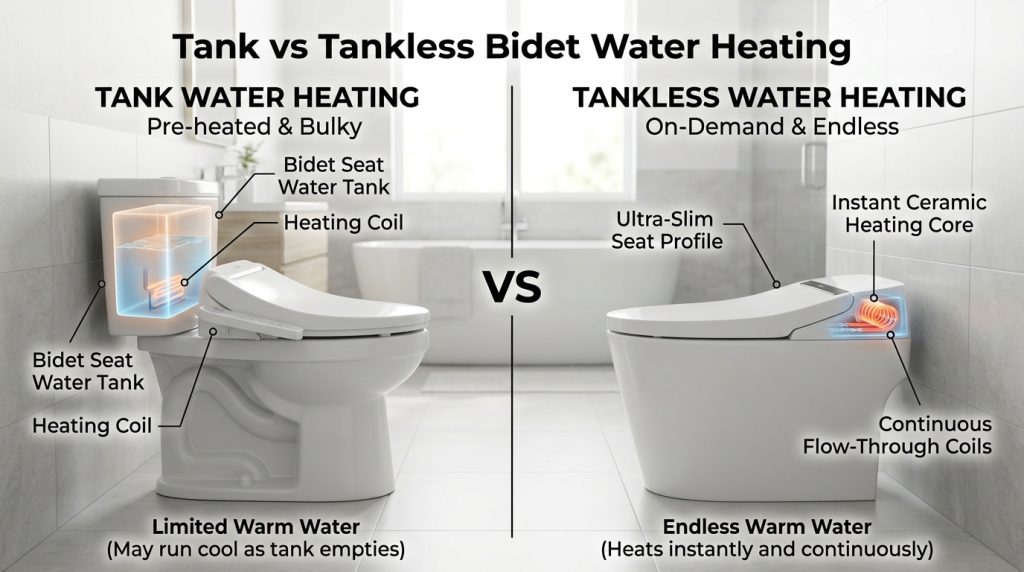
In tank vs tankless bidet water heating, the primary difference lies in water duration and design profile. A tank model stores pre-warmed water in a small reservoir, providing 30 to 60 seconds of heat before cooling down. A tankless system uses an instant ceramic flash heater to produce continuous, unlimited warm water on demand while maintaining a much slimmer seat profile.
| Feature | Tank | Tankless |
| Warm water duration | About 30 to 60 seconds; some tanks up to 2 minutes | Unlimited during the wash |
| Warm-up speed | Warm from the first second | 0.25 to 1 second of cool water on some units |
| Reheat after use | 3 to 5 minutes | None |
| Peak power | About 600 to 1,500 W while heating | About 1,050 to 1,500 W during a wash |
| Standby power | Reservoir kept warm when idle | Heater idle between washes |
| Seat profile | Bulky, raised rear | Slim, low profile |
| Typical price | About $200 to $350 for entry models | About $400 to $800+ |
What Is a Tank-Type Bidet Water Heater?
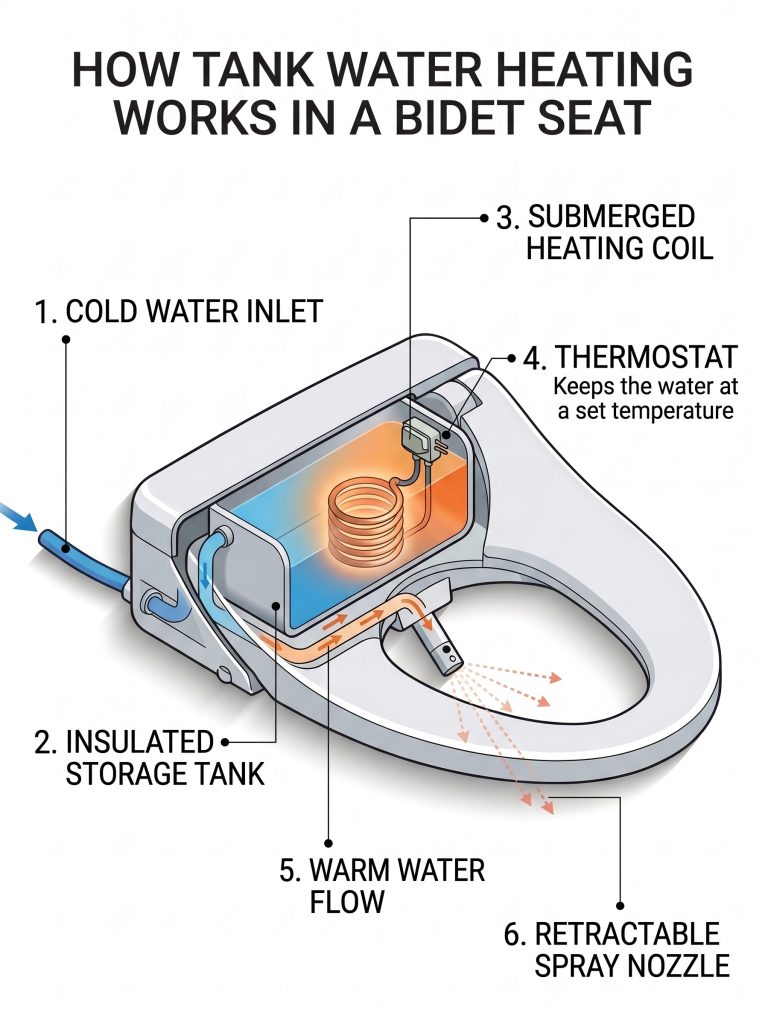
A tank bidet water heater is a small reservoir built into the back of the seat, not the toilet’s own tank. It stores water that is already warm, which is why tank seats are the cheapest electric option.
How Tank Water Heating Works
Water from the supply line fills the reservoir. An internal heating coil warms it and holds it at your chosen temperature, so it is ready before you sit down. When you start a wash, a pump pushes the stored water through the nozzle. Once the reservoir empties, it refills and reheats, which is roughly 3 to 5 minutes.
To stay ready, the tank keeps drawing power even when nobody is using the seat. Eco modes reduce that by lowering the heater’s target between uses.
Warm-water time depends on tank size. Architecture Lab 30 to 50 seconds, and Bio Bidet says a full tank can last up to two minutes. The Bio Bidet BB-1000 is rated at about 60 seconds per cycle. Tank seats also tend to spray harder: the BB-1000 lists a flow of 0.32 gallons per minute, against 0.11 for the tankless Brondell Swash 1400.
Pros of Tank Bidets
- Lower upfront price. Higher water pressure and hotter temperature settings deplete a tank bidet’s warm water reserve faster.
- Warm from the first second. There is no cool burst at the start of a wash.
- Lower peak wattage. It’s about 600 W for tank seats against about 1,400 W for tankless. Other sources list higher tank figures, so check your model’s spec sheet.
- Lighter circuit load. One electrical guide says a light tank-style seat can often share a bathroom circuit.
- Steady temperature. The water is heated in advance, so it does not swing mid-wash.
- Proven design. Tank seats have been sold for decades.
Cons of Tank Bidets
- A short warm window. After roughly 30 to 60 seconds the spray drifts toward room temperature, which cuts off longer washes.
- A 3 to 5 minute reheat. A second person right behind you gets cool water.
- A bulky rear slope. The reservoir raises the back of the seat. You sit farther forward, and the seat can feel cramped.
- Standby energy use. Tank bidet seats are the least energy-efficient option because they continuously draw standby power to keep stored water warm.
What Is a Tankless (On-Demand) Bidet Water Heater?
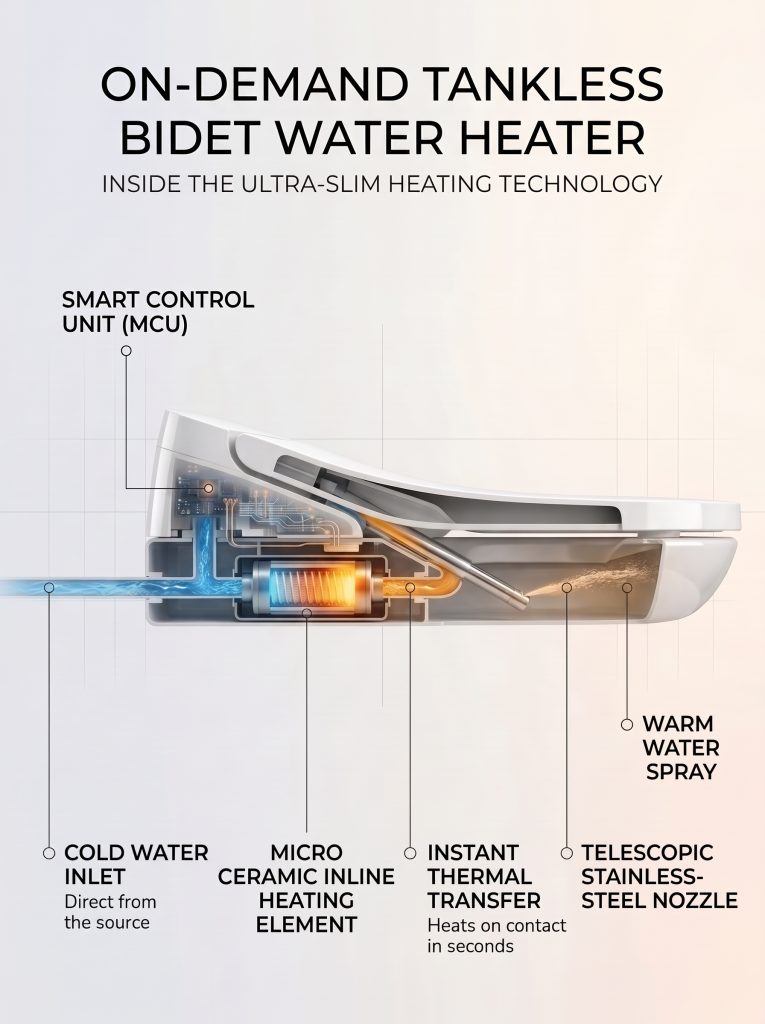
A tankless bidet water heater has no reservoir. Cold supply water is heated only while the spray is running, so the seat never stores warm water.
How Tankless Bidet Water Heater Works
Instead of maintaining a standing pool of hot water, a tankless seat routes municipal cold water through high-performance ceramic heating tubes. As water flows through the chamber, high-wattage micro-coils instantly bring it to your selected temperature in real time, sustaining that exact temperature indefinitely.
Pros of Tankless Bidets
- Endless warm water. The stream lasts as long as the wash does, which suits long washes and shared bathrooms.
- No standby loss from a reservoir. The heater draws power only while the spray is on. The seat warmer, remote and other electronics still draw some power, so use an eco mode.
- A slim profile. With no tank, the seat sits lower and looks closer to a regular seat. This gives a larger sittable area.
- Best efficiency of the three. Tankless as the most efficient, since the heater runs only during a wash.
Cons of Tankless Bidets
- A higher price. Bidets with instant water heaters are consistently the most expensive models on the market.
- A brief cool start on some units. While standard tankless seats typically spray leftover unheated line water for 0.25 to 1 second before reaching temperature, high-end models with specialized ceramic heaters eliminate this initial cool burst entirely.
- High peak draw. Tankless bidet seats typically draw 12 to 14 A (1,400 to 1,500 W) during active heating, so installing a dedicated 20 A circuit is widely recommended to prevent tripped breakers.
- Gentler spray. Tankless seats usually spray softer than tank models, and the Swash 1400’s 0.11 gallons per minute fits that pattern.
- Hard water buildup. Installing an inline water filter is strongly recommended to prevent mineral buildup and protect internal bidet valves.
Head-to-Head Comparison: Tank vs Tankless Bidet Water Heating
Warm Water Duration: 60 Seconds vs Unlimited
This is the biggest practical difference in tank vs tankless bidet water heating. A tank gives roughly 30 to 60 seconds, then 3 to 5 minutes to reheat. A tankless seat keeps going.
For one person with a quick rinse, 60 seconds is enough. For two people using the bathroom back to back, the second wash may start on a cooling tank. Multi-person households, longer washes and anyone who likes to take their time lean tankless. A tank bidet’s warm water duration fluctuates based on your chosen spray pressure and temperature settings.
Energy Efficiency & Electricity Costs
Tank seats hold a small standby draw; tankless seats take a large burst. The totals are small either way.
Published standby figures for tank seats are scarce. BidetMate lists a heated seat at roughly 50 to 70 watts and a tank heater at up to 850 W while actively heating. Tank bidet seats typically peak between 600 W and 1,500 W depending on the model, whereas tankless seats consistently draw 1,400 to 1,500 W during active flash heating.Sources disagree, so read your model’s label.
Spraying water for 3 minutes a day uses only about 24 kWh annually (~$4 at typical rates), while keeping a 50 W heated seat on 24/7 can draw up to 438 kWh per year (~$75), based on U.S. Energy Information Administration residential rate data. Because actual seats cycle automatically and include eco modes, real-world standby usage is much lower—switch on the energy saver to keep operating costs minimal.
Design and Ergonomics (Seat Profile & Fit)
Tank seats raise the rear to fit the reservoir. You sit farther forward and the seat can feel smaller. Tankless seats are slim and sit closer to a standard seat. Some tankless-style retrofit sheet lists dimensions of about 20-1/2 by 17-1/4 by 5-1/4 inches.
Check clearance before buying. A raised rear needs room under the toilet lid and against the tank. Seat shape matters too: measure from the mounting bolts to the bowl front. About 16.5 inches is round and about 18.5 inches is elongated, per Bio Bidet.
Electrical Demands & Circuit Safety
Every electric seat needs a GFCI-protected outlet within reach of its cord. Manufacturer guides specify at least a 15 A GFCI outlet, and some lists a 10 A minimum circuit. Appliance-repair guidance puts tank seats at 10 to 13 A on a 15 to 20 A breaker and tankless seats at 12 to 13 A on a 20 A breaker.
The reason is peak draw. An instant heater briefly pulls close to what a hair dryer does. If a tankless seat shares a circuit with a hair dryer or heated fan, it can trip the breaker. A light tank seat usually can share. If you have no GFCI outlet nearby, an electrician has to add one, and older homes may lack grounded outlets. Follow the manual rather than using an extension cord.
Upfront Price vs Long-Term Value
Entry tank seats generally run about $200 to $350. A retailer sale listing had the Bio Bidet BB-1000 Supreme, a tank model, at $269. Tankless seats generally run about $400 to $800 or more. Ceramic-heated bidet models start around $450, while premium luxury seats generally range between $500 and $800.
Running costs barely separate them, since a seat’s electricity runs to a few dollars a year in the Wattstokwh model. The gap is mostly upfront. Value depends on use: a single person doing quick rinses gets nothing extra from tankless, while a family gets daily use out of it.
The Alternative: What Is a Hybrid Bidet Water Heating System?
If you find yourself torn between both ends of the spectrum, hybrid models offer a middle-of-the-road alternative. A hybrid bidet seat pairs a miniature reservoir (holding roughly 10 to 15 seconds of water) with a secondary flash heater.
This design delivers immediate warmth on second one while maintaining an extended warm spray for up to two minutes. While hybrids still require a slightly raised rear casing, they deliver excellent temperature stability at a mid-range price point ($250 to $400).
Buyer’s Guide: Which Water Heating Method Fits Your Bathroom?
When to Choose a Tank Bidet
Choose a tank bidet water heater if you live alone or with one other person, keep washes short, and want the lowest price. It is also a better fit for older wiring, since it draws less at peak and can usually share a circuit. Before buying, confirm the warm window on the spec sheet, check rear clearance against your lid and tank, and make sure you have a GFCI outlet.
When to Choose a Tankless Bidet
Choose a tankless bidet water heater if you have a family, expect back-to-back use, want longer washes for postpartum or medical comfort, or prefer a slimmer seat. Some electronic seats are one tankless-style option, with a 3-year limited warranty and a 120 V, 10 A minimum circuit requirement on the spec sheets reviewed.
Check three things first: a dedicated circuit with GFCI protection, your water hardness, and the brand’s cool-start claim.
Frequently Asked Questions About Bidet Water Heating
How long does warm water last in a tank-type bidet?
About 30 to 60 seconds on most seats. Larger tanks can last up to two minutes, according to Bio Bidet. After the tank empties, reheating takes about 3 to 5 minutes. The exact window shifts with the pressure and temperature you select.
Does a tankless bidet use more electricity than a tank bidet?
It draws more power while washing, around 1,050 to 1,500 W, but only during the wash. A tank seat draws less at peak and keeps its reservoir warm when idle. BidetKing rates tankless as more efficient overall. In dollar terms the gap is small, since one calculator models roughly 24 kWh a year for an electric seat, about $3.
Can a tankless bidet trip my bathroom circuit breaker?
Yes, if the circuit is overloaded. A tankless seat pulls 12 to 14 A, and an electrical guide says it briefly draws almost as much as a hair dryer. Sharing a circuit with a hair dryer or heated fan is the usual cause. Use a dedicated circuit where the manual calls for one. A GFCI outlet trips for a different reason, a ground fault.
Is tankless water heating safe from bacterial growth?
No head-to-head study of tank and tankless bidet seats turned up. Tankless seats have no reservoir where warm water sits, which is a plausible advantage. General water-system evidence is mixed: in one hospital case, removing storage tanks had little effect because biofilm in the pipes harbored the bacteria. Bidet-specific research points to the nozzle.
A 2022 study found no upstream migration of microbes from the nozzle to the seat’s water tank, and daily nozzle cleaning lowered bacterial counts. Use the self-clean function and clean the nozzle regularly with either type.
Final Thoughts: Making the Right Choice
When deciding on tank vs tankless bidet water heating, the best choice rests on your wash habits, household size, and budget.
If you are a solo user seeking a simple, budget-conscious upgrade, a reliable tank bidet water heater provides dependable comfort for short rinses. However, if your budget allows and you share your home with family, investing in an instant tankless bidet water heater delivers continuous warmth, superior energy efficiency, and a sleek modern profile that stands the test of time.