When shopping for personal hygiene upgrades, the promise of a hands-free, maintenance-free bathroom is enticing. Central to that promise are self-cleaning bidet nozzles, an engineering feature found across modern attachments, replacement seats, and integrated smart fixtures.
Yet, a frequent question remains: does “self-cleaning” mean a nozzle never gets dirty, or is it a marketing label for a basic water rinse?
Understanding the mechanics, sanitizing technologies, and physical boundaries of self-cleaning bidet nozzles ensures your fixture stays sanitary, protects your health, and performs reliably for years.
How Do Self-Cleaning Bidet Nozzles Work?
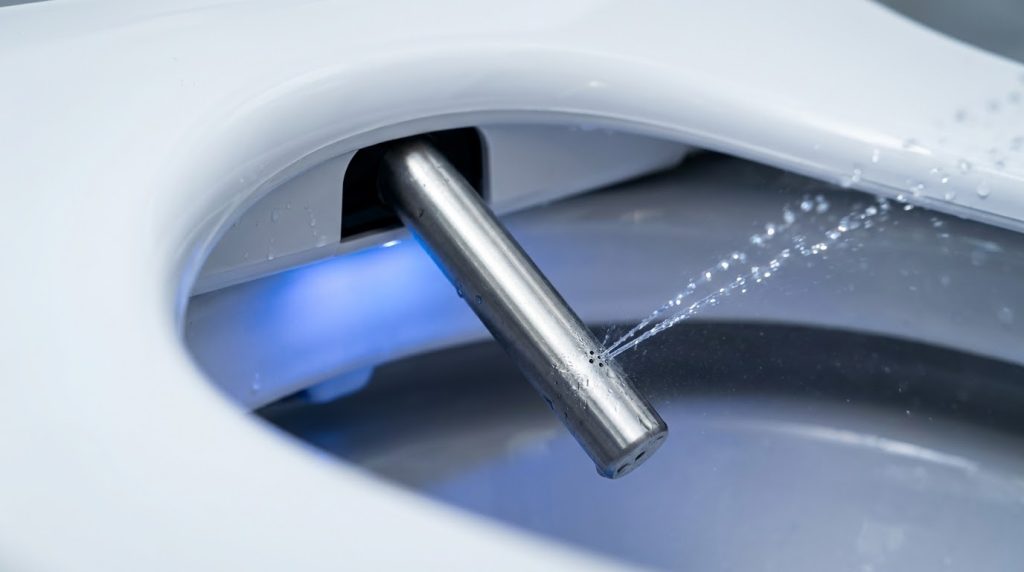
A self-cleaning cycle prevents dried residue from sticking to the spray wand by rinsing its surface before and after use. The actual mechanics vary depending on whether you choose between an electric or non-electric bidets.
Mechanical Flushing in Non-Electric Attachments
On a mechanical bidet attachment, the cleaning cycle operates manually using static water line pressure. The control console features a dial or lever with a dedicated “Nozzle Clean” position.
When turned to this setting, the internal valve directs incoming potable water over the retracted wand body behind a protective plastic splash guard. Because the pressure does not push the piston forward into the spray position, the water simply washes down the shaft and drains into the bowl. This rinses away superficial dust or droplets before you angle the stream for personal washing.
Automated Pre- and Post-Rinsing in Electric Seats
Electric bidet seats automate this entire sequence via circuit boards and solenoid valves:
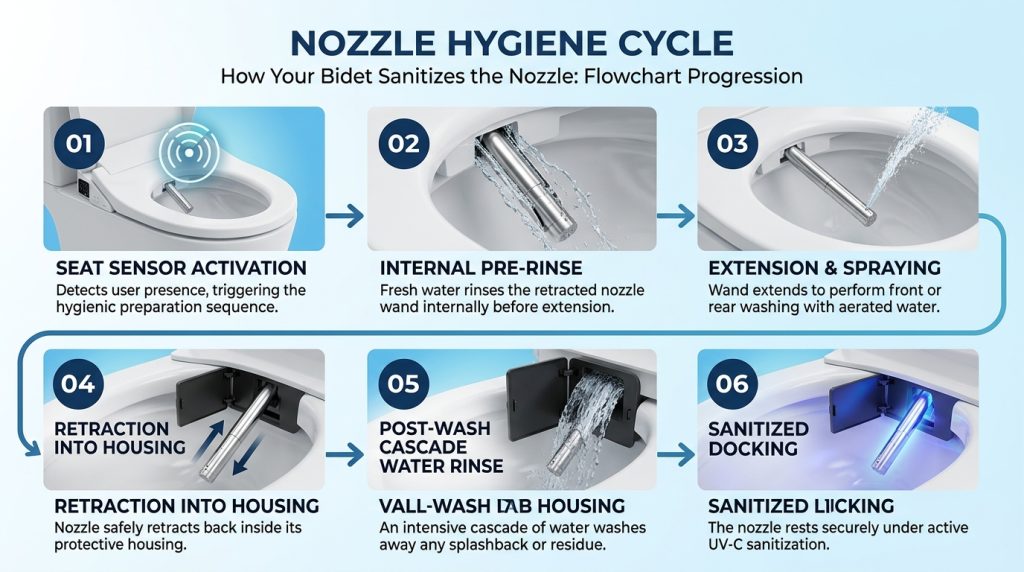
- Pre-Rinse: When the capacitive seat sensor detects a user sitting down, the unit flushes fresh water over the nozzle head inside its internal chamber for 3 to 5 seconds.
- Wash Cycle: The motorized wand extends into the bowl, targets the user, and conducts the wash.
- Post-Rinse: As the wand retracts into the housing, high-pressure water jets rinse down the exterior wand body, washing away fresh splashback before the wand docks.
This baseline mechanism answers the common hygiene question: do bidets spray poop everywhere?
No. Because the nozzle only extends during active washing and flushes itself before docking, it remains shielded from waste evacuation.
Advanced Sterilization: Electrolyzed Water and UV-C Light
High-end manufacturers go beyond mechanical water rinsing by integrating active antimicrobial sanitization:
- Electrolyzed Water (eWater+): Used extensively by top brands, incoming tap water passes over active titanium electrodes. This electrolysis process breaks down chloride ions into a dilute solution of hypochlorous acid (HOCl)—a safe disinfectant that neutralizes surface bacteria on the wand and bowl. Within hours, the solution reverts to ordinary water.
- Germicidal UV-C Illumination: Miniature ultraviolet LEDs shine directly onto the retracted nozzle tip inside the dark housing chamber. According to the Centers for Disease Control and Prevention (CDC), targeted UV-C radiation disrupts microbial DNA and RNA, inactivating pathogens without requiring toxic chemical cleaners.
The Limitations of Self-Cleaning Bidet Nozzles
While automated rinsing keeps nozzles significantly cleaner than unwashed fixtures, relying exclusively on self-cleaning cycles creates sanitary blind spots over time.
1. Mineral Calcification and Hard Water Scale
Self-cleaning functions rely on municipal tap water. If your home has hard water rich in dissolved calcium and magnesium carbonates, continuous rinsing can exacerbate scale buildup.
As water evaporates off the nozzle tip between uses, white crust (limescale) precipitates around the microscopic spray apertures. Self-cleaning rinses cannot dissolve mineral deposits. Over several months, calcification distorts spray trajectories, reduces water pressure, and creates rough surfaces where bacteria can cling.
2. The Blind Spot: Splashback and Housing Cavities
A self-cleaning rinse cleans the wand shaft, but it rarely reaches the nozzle housing pocket or the underside of the splash-guard gate.
During high-velocity bowl flushes or loose bowel movements, microscopic aerosol droplets settle on the crevices around the nozzle pocket. If left uncleaned, this recessed pocket becomes a harbor for bacteria that self-cleaning water cycles cannot dislodge.
3. Biofilm, Slime, and Mold in Humid Bowls
Toilet bowls provide a warm, humid environment ideal for airborne fungi like Serratia marcescens (the common pink bathroom bacteria) and black mold. These organisms form a sticky extracellular matrix known as a biofilm.
A passive stream of unheated water cannot penetrate or strip away an established bacterial biofilm. Without periodic physical friction such as brushing the nozzle will eventually develop a slippery bacterial film.
The Pros of Self-Cleaning Bidet Nozzles
- Automatic Pre- and Post-Rinse Protection:
The wand automatically cascades fresh, potable water over its surface before extending and immediately upon retracting. This instantly flushes away fresh water droplets and micro-particles before they can dry, stick, or harden onto the nozzle body.
- Shielded Retraction Chamber:
During standard bowel evacuation and bowl flushing, the wand remains safely tucked inside an internal, shielded chamber behind a protective splash-guard gate. It only extends when you press a wash button, keeping the nozzle away from direct waste contact.
- Drastically Cuts Down Manual Scrubbing:
By handling everyday surface rinsing automatically, self-cleaning mechanisms save time and eliminate the need for daily hands-on scrubbing inside the toilet bowl.
- Enhanced Multi-User Hygiene:
In shared family bathrooms or guest powder rooms, an automated rinse before every cycle gives users complete peace of mind that the wash wand is freshly sanitized with clean municipal water.
- Advanced Medical-Grade Sterilization:
Top-tier electric models pair self-cleaning water flushes with active antimicrobial defenses including electrolyzed water (eWater+) that acts as a natural disinfectant and germicidal UV-C light that neutralizes bacteria and viral DNA inside the nozzle housing.
- Resists Mineral and Residue Adhesion:
Constantly flushing the wand keeps its surface wet and lubricated, preventing fecal particles, bathroom dust, and airborne spores from settling onto the plastic or stainless steel apertures.
- Zero Chemical Wear:
Automated cycles clean with clean water alone, eliminating the need for abrasive scrubbing powders or harsh chemical bleaches that can degrade internal rubber O-rings, dissolve valve gaskets, or void your manufacturer warranty over time.
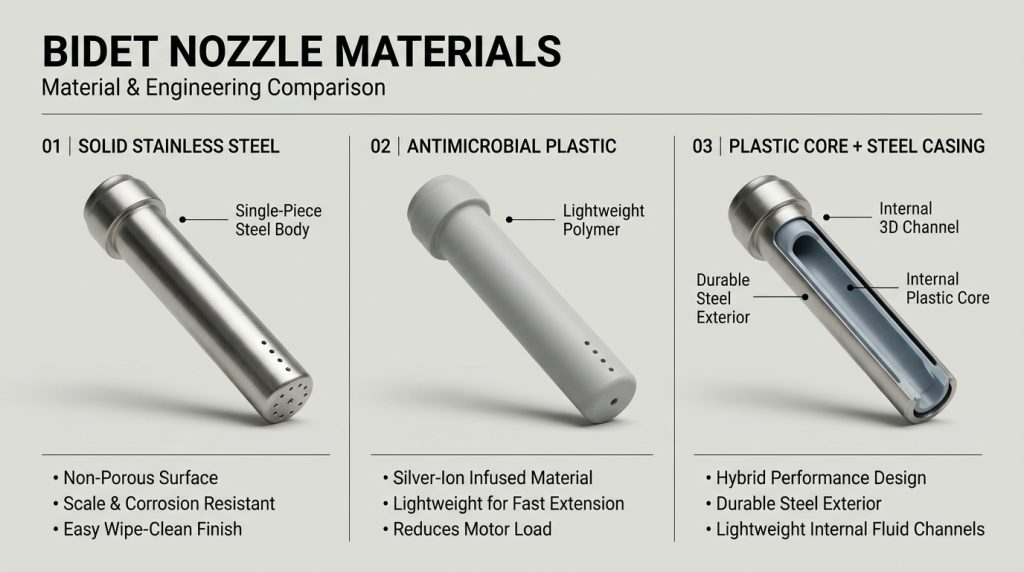
Material Science: Stainless Steel vs. Antimicrobial Plastic Wands
The material of your bidet wand directly influences how well its self-cleaning mechanism works:
| Wand Material | Surface Porosity | Bacterial Resistance | Scaling Vulnerability | Overall Longevity |
| Solid Stainless Steel | Ultra-Low (Smooth) | High (Non-porous) | Moderate (Wipes off easily) | 8 – 12+ Years |
| Silver-Ion ABS Plastic | Low (Treated polymer) | High (Inhibits growth) | High (Prone to scale adhesion) | 5 – 8 Years |
| Standard Raw Plastic | Moderate (Micro-pores) | Low (Relies on water) | Very High (Grit sticks to pores) | 2 – 4 Years |
Stainless steel wands provide superior long-term performance. Their non-porous finish allows self-cleaning water sheets to glide down the wand without catching, preventing early mineral scale and discoloration.
Best Practices: Manual Maintenance and Routine Care
A self-cleaning cycle is a daily maintenance aid, not a total replacement for routine bathroom sanitation. To keep your unit in top condition, follow this care routine:
Step 1: Manually Extend the Wand
Never force the wand out with your fingers, as this can strip the plastic internal gears. Instead:
- Electric Units: Press the “Nozzle Clean” button on your wireless remote or side console to extend the wand without activating the spray.
- Mechanical Attachments: Turn the dial to the cleaning position and pull the wand downward gently using the designated plastic tab.
Step 2: Use Mild, Non-Abrasive Cleaners
Dip a soft-bristled toothbrush into warm water mixed with mild liquid dish soap or diluted white vinegar. Gently scrub the spray tip, apertures, and the back side of the wand.
Avoid harsh toilet bowl bleaches, hydrochloric acid, or abrasive scouring pads. Harsh chemicals degrade silicone seals, pit stainless steel, and strip antimicrobial coatings off plastic nozzles.
Step 3: Clear Hard-Water Mineral Deposits
If spray holes are partially blocked, soak a paper towel in pure white vinegar and wrap it around the nozzle tip for 15 to 20 minutes to dissolve calcium carbonate deposits. Scrub with a soft brush and run a manual rinse cycle to flush the lines.
Are Self-Cleaning Bidet Nozzles Truly Sanitary?
The short answer is yes, when maintained with basic common sense.
According to plumbing evaluations by the International Association of Plumbing and Mechanical Officials (IAPMO), modern bidet seats certified under standard ASME A112.4.2 incorporate engineered air gaps and backflow preventers. This design ensures that wash water never siphons back into your home’s potable drinking lines.
Furthermore, water washing is significantly cleaner than dry friction. Understanding bidet hygiene shows that washing with clean water eliminates fecal bacteria rather than smearing it across perianal skin.
For female users asking if bidets are sanitary for females, self-cleaning nozzles provide hygienic rinses during menstruation and postpartum recovery — provided the stream is directed from front to back to avoid transferring colon bacteria toward the urethra.
Hygiene Safety Protocol:
- Verify automated pre-rinse before every cycle.
- Direct spray strictly from front to back for feminine cleansing.
- Do a proper nozzle cleaning always and perform a 2-minute manual soft-brush scrub every 3 to 4 weeks.
Conclusion
Self-cleaning bidet nozzles are an essential convenience feature that keeps bathroom fixtures hygienic between regular cleanings. By rinsing the wand before and after every use, they shield personal wash components from dried residue and airborne bathroom particles.
However, “self-cleaning” does not mean “maintenance-free.” Automated water cycles cannot dissolve heavy mineral scale, strip away established fungal biofilms, or scrub the hidden housing pockets inside the toilet rim.
To enjoy the full benefits of your bidet, treat the self-cleaning cycle as your primary day-to-day defense, supplemented by a quick, two-minute manual brush once a month.